Categories
New Blog
Caramel popcorn usually burns during production because the caramel is exposed to excessive heat, heated for too long, or not mixed evenly. Caramel residue on hot equipment, inconsistent ingredient feeding, and unsuitable batch sizes can also cause dark spots, bitter flavors, and uneven coating.
For commercial popcorn manufacturers, preventing burnt caramel is not just a matter of adjusting the temperature. The entire process, from caramel preparation and popcorn feeding to mixing and cooling, needs to be controlled consistently. Understanding where burning occurs helps operators reduce product waste and produce caramel popcorn with a more uniform color, flavor, and texture.
The most common cause is excessive heat combined with insufficient control over cooking time and mixing. Sugar changes rapidly as it heats, and once caramel becomes too dark or begins to scorch, its flavor can turn bitter. Even if the average temperature appears acceptable, localized hot spots or caramel that remains against a hot surface for too long can still burn.
In a commercial production environment, operators should investigate the caramel cooking stage, the coating stage, and the condition of the equipment separately. Burnt flavor may originate in the caramel itself, while black specks or isolated dark patches may indicate residue or uneven heat distribution.
For manufacturers looking to improve coating consistency, XFD offers a range of popcorn coating machines for different production requirements.
Sugar-based caramel is sensitive to both temperature and heating time. If the mixture is heated too aggressively, the surface may darken before the ingredients are evenly combined. Continuing to apply heat after the caramel has reached the required cooking stage increases the risk of scorching and bitter flavors.
Several operating conditions can contribute to this problem:
The correct temperature depends on the recipe, sugar composition, moisture level, equipment design, and desired finished product. There is no single temperature that works for every caramel popcorn formula. Manufacturers should establish a validated operating range through controlled production trials rather than relying on a universal setting.
XFD's industrial popcorn cooker and coater combines cooking and mixing functions. Its adjustable digital temperature control is designed to help operators set and monitor process conditions according to the requirements of their ingredients and recipes.
Yes. Poor mixing can create uneven heating and coating, leaving some popcorn pieces covered with thick caramel while others receive very little. Caramel that accumulates in one area may remain in contact with a hot surface for longer, increasing the risk of localized scorching.
Mixing becomes especially important when production volumes increase. Manual handling or equipment that cannot accommodate the batch size may struggle to maintain consistent movement throughout the mixture.
To improve mixing consistency, production teams should:
The industrial caramelizer shown below is designed for large-scale popcorn coating applications. Its mixing components help distribute caramel across the batch, while the operating settings should be adjusted to suit the recipe and production requirements.
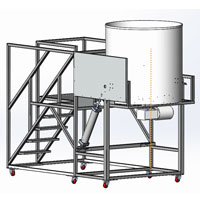
For factory-scale applications, XFD's factory popcorn cooker and caramelizer features adjustable digital temperature control and an independently controlled stirring system. These features help operators manage heating and mixing during production.
Caramel residue is another common reason for burnt flavors and dark particles in finished popcorn. When leftover sugar remains on a heated surface, it may continue to darken during subsequent batches. Over time, the residue can become difficult to remove and affect both product appearance and flavor.
This problem is more likely to occur when equipment is not cleaned at suitable intervals, when caramel accumulates around mixing components, or when production continues without checking areas where the mixture tends to collect.
Preventive measures include:
Cleaning should be performed using the approved shutdown, cooling, and cleaning procedure for the equipment. Operators should never reach into moving machinery or attempt to remove residue from hot equipment without following the applicable safety procedure.
Ingredient composition influences caramel viscosity, heating behavior, and the way the coating develops. A change in sugar type, fat content, water quantity, or ingredient quality can affect how quickly the caramel cooks and how evenly it spreads over the popcorn.
Too little moisture during caramel preparation may cause the mixture to heat unevenly, depending on the recipe and process. Excess moisture can create a different problem: the coating may take longer to reach the desired consistency, extending the time the mixture remains under heat.
Manufacturers should keep ingredient ratios consistent and record recipe changes during production trials. If a new batch begins to burn, check whether the ingredient supplier, formulation, batch size, or preparation procedure has changed.
It is also important to distinguish burnt caramel from sticky caramel. A sticky finished product does not necessarily mean the caramel has burned. Insufficient drying, incomplete cooling, high ambient humidity, or moisture entering through packaging may cause stickiness even when the caramel has been cooked correctly.
For manufacturers developing a consistent caramel popcorn recipe, XFD's caramel popcorn coating powder is another option to evaluate. Its compatibility with the production process should be tested using the intended equipment and recipe.
The most effective approach is to control the entire process instead of correcting temperature alone. A stable production routine makes it easier to identify the source of a problem before a large quantity of popcorn is affected.
Manufacturers can start with the following practical checks:
When a batch burns, avoid changing several process variables at once. Instead, identify whether the problem occurs during caramel cooking, coating, or subsequent handling. Adjust one relevant variable at a time and verify the result with a controlled trial.
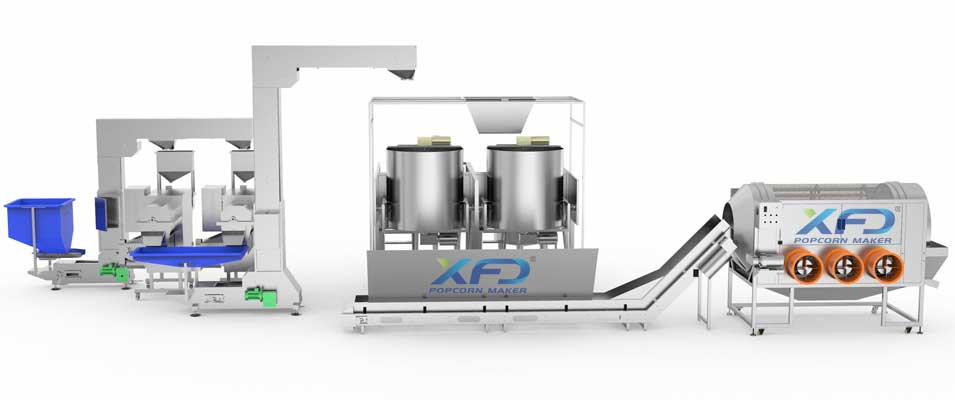
For larger operations, XFD's industrial popcorn production and coating line integrates popcorn processing and caramel coating equipment. The system features an adjustable digital temperature display and control, an automatic alarm system, and a modular design. Actual production settings should still be established for the recipe and operating conditions.
A simple troubleshooting sequence helps operators locate the problem more quickly. Start by checking the appearance and flavor of the caramel before it reaches the popcorn. If the caramel is already dark or bitter, investigate the cooking stage first. If the caramel tastes normal but the finished popcorn contains dark patches, inspect the coating process, mixing performance, and equipment surfaces.
| Observed problem | Possible cause | Recommended check |
|---|---|---|
| Caramel is dark and bitter before coating | Excessive heating or cooking time | Review temperature, cooking time, and recipe |
| Black specks appear in the finished product | Burnt residue or localized scorching | Inspect product-contact surfaces and mixing components |
| Some popcorn pieces are much darker than others | Uneven mixing or coating | Check agitator operation, loading, and ingredient feeding |
| Caramel becomes sticky after production | Moisture, cooling, or packaging issues | Review cooling conditions, moisture exposure, and packaging |
| Burning develops after several batches | Progressive caramel buildup or changing process conditions | Inspect residue and compare batch records |
Equipment selection matters because the caramelizer must suit the required output, recipe, batch size, and coating method. A machine that is too small for the production target may create a bottleneck, while an unsuitable mixing system may make it difficult to maintain even coating across a batch.
When evaluating a commercial or industrial caramelizer, manufacturers should consider temperature adjustment, mixing performance, working capacity, cleaning access, and compatibility with upstream popping equipment and downstream cooling or packaging systems.
For smaller commercial operations, XFD's CA-480 cooker and coater caramelizer is designed for batch-based caramel popcorn production. For larger factories, industrial cooker-and-coater equipment and integrated production lines may be more suitable, depending on required output and the planned production workflow.
The right equipment does not eliminate the need for recipe control or operator training. Instead, suitable temperature adjustment, mixing, and production monitoring give manufacturers more practical ways to maintain consistent quality and investigate problems when they occur.
Why does caramel popcorn burn even when the temperature seems correct?
The displayed temperature may not reflect every part of the caramel mixture. Localized hot spots, long cooking times, uneven mixing, and caramel residue can cause scorching even when the set temperature appears normal. Check actual process conditions and inspect the equipment.
What is the main cause of bitter caramel popcorn?
The most common cause is caramel that has been heated too strongly or for too long. However, burnt residue from previous batches and ingredient changes can also create bitter flavors.
Can a popcorn caramelizer reduce burning during production?
A suitable caramelizer can help improve temperature adjustment and mixing consistency. XFD industrial caramelizers feature adjustable digital temperature controls, and selected models include independently controlled mixing systems. Results depend on the recipe, operating settings, maintenance, and production conditions.
Why does caramel popcorn burn more often during large-scale production?
Large-scale production introduces additional challenges, including higher ingredient throughput, longer production runs, uneven feeding, and residue buildup. Appropriate equipment capacity, stable feeding, consistent mixing, and routine inspection help reduce these risks.
Does burnt caramel mean the popcorn is too dry?
No. Burnt caramel is usually associated with excessive heating, prolonged cooking, or localized scorching. Dryness and crispness are separate product-quality factors, although moisture and formulation can influence caramel cooking behavior.
How can a factory identify the stage where caramel popcorn burns?
Inspect the caramel before coating, then compare it with the coated popcorn and the cooled finished product. If the caramel is already bitter, investigate cooking conditions. If the problem appears only after coating, check mixing, equipment residue, and subsequent handling.
What information should manufacturers record when troubleshooting burnt caramel popcorn?
Record the recipe, ingredient lots, batch size, temperature settings, cooking duration, mixing settings, time between cleaning, and the stage at which discoloration or bitterness first appears. These records help identify repeatable causes instead of relying on guesswork.
If burnt caramel is affecting your production quality, review the cooking and coating process before changing the recipe. Explore XFD's industrial popcorn machine range to compare equipment options for your production requirements.
 No.58 TongMing Road,TongAn District,XiaMen City,FuJian Province
 +86-592-5701935
If you are interested in any XFD product, please leave us a message, we will reply to you soon.
Copyright © 2012-2026 XFD XIAMEN MACHINERY TECHNOLOGY LTD..All Rights Reserved.
 English
 Deutsch
 русский
 español
 português
 Nederlands
 العربية
 हिंदी
हिंदी