Categories
New Blog
Commercial caramel popcorn is made by popping corn kernels, preparing a caramel coating, mixing the popcorn with the coating, and cooling the finished product before packaging. In a commercial popcorn factory, these operations can be handled by individual machines or integrated into an automated production line, depending on the required output and product specifications.
For manufacturers, the challenge is not simply making caramel popcorn. It is producing consistent batches with an even caramel coating, a crisp texture, a balanced sweetness, and minimal product loss. XFD provides industrial popcorn production equipment, including popcorn popping machines, caramelizers, coating systems, and integrated production lines designed for commercial food processing.
The main ingredients used in commercial caramel popcorn are popcorn kernels, sugar, oil or fat, and, depending on the recipe, ingredients such as butter, glucose syrup, salt, or other flavoring components. The exact formulation depends on the desired sweetness, color, coating thickness, texture, and shelf-life requirements.
Ingredient ratios should be tested and standardized before full-scale production. Too much moisture in a coating can affect crispness, while excessive heat can darken the caramel and create bitter notes. A recipe that works in a small kettle may also require adjustment when transferred to an industrial caramelizer.
For businesses developing different popcorn flavors, XFD also offers popcorn production and flavoring equipment for commercial and industrial applications.
A typical commercial caramel popcorn manufacturing process includes raw material preparation, popping, caramel cooking, coating, cooling, quality inspection, and packaging. Depending on the equipment configuration, some operations may take place in separate machines, while others are connected through automated feeding and conveying systems.
Raw material preparation: Kernels and other ingredients are checked and measured according to the production recipe. Consistent ingredient quality and accurate dosing help reduce batch-to-batch variation.
Popcorn popping: The kernels are heated using the selected popping technology. A commercial operation must control heating conditions and remove unpopped kernels or excessive debris where the equipment configuration allows.
Caramel preparation: Sugar and the other ingredients specified in the recipe are heated and mixed to create the required caramel coating. Temperature, cooking time, moisture, and ingredient proportions influence the final color, flavor, and consistency.
Coating and mixing: The popped corn is combined with the prepared caramel in a suitable cooker, mixer, or caramelizing machine. Controlled agitation helps distribute the coating across the popcorn while reducing excessive clumping.
Cooling and separation: The coated popcorn is cooled under controlled conditions so the caramel can set. Cooling and separation equipment can help remove excess fines and separate pieces that stick together.
Inspection and packaging: The finished popcorn is checked for coating consistency, texture, flavor, and foreign material before being packed in packaging suitable for the intended product and distribution conditions.
For a factory, these stages should be designed as one coordinated workflow. The popping section, caramelizer, conveyor, cooling system, and packaging equipment need compatible capacities to avoid bottlenecks and unnecessary waiting time.
The equipment required depends on daily production volume, the type of popcorn, the caramel recipe, available floor space, and the desired level of automation. A small gourmet popcorn operation may use a popping machine and a separate caramelizer, while a larger manufacturer may need an integrated line with automatic feeding, coating, cooling, and conveying.
Popcorn popping machine: This equipment converts raw kernels into popcorn. Hot-air and electromagnetic popping systems are among the options available for commercial and industrial production. The right choice depends on product requirements, throughput, and the overall process design.
Caramelizer or cooker and coater: This machine prepares or handles the caramel coating and mixes it with popcorn. For industrial production, the mixing structure, heating control, working volume, and discharge method all influence coating performance and ease of operation.
Conveying and feeding equipment: Automated feeding and conveyors transfer popcorn and ingredients between processing stages. Correctly matched equipment helps maintain a steady flow and reduces the need for repeated manual handling.
Cooling and separating equipment: These systems help cool the caramel-coated popcorn and separate individual pieces before packaging. Their capacity should be matched to the upstream coating process.
Packaging equipment: Packaging protects the product during storage and distribution. The packaging format and sealing performance should be selected with moisture protection, product freshness, and the target market in mind.
For a dedicated caramel popcorn operation, the XFD industrial popcorn cooker and coater is designed for professional popcorn production. It combines cooking and mixing functions and includes adjustable digital temperature control to support process management.
An industrial caramelizer helps manufacturers manage heating and mixing more consistently than a process that relies entirely on manual handling. Its performance depends on the machine design, the recipe, the batch size, and the operating settings.
During coating, popcorn needs to move through the caramel mixture without excessive crushing or uneven accumulation. Effective agitation helps distribute the coating, while controlled heating helps operators avoid scorching the sugar. The objective is to achieve the required coating coverage without creating too many clusters or leaving large numbers of kernels insufficiently coated.
Temperature control is particularly important because caramel can change quickly when overheated. Operators should establish recipe-specific temperature and time settings through production trials rather than relying on a single temperature for every formulation.
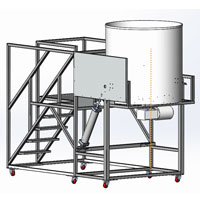
The XFD large caramelizer and industrial cooker and coater is another option for factories that need to process coated popcorn and other snack products. Its suitability should be evaluated against the required output, recipe, mixing behavior, and available production space.
An automated caramel popcorn production line connects multiple processing stages so that ingredients and products can move through the factory with less manual handling. Depending on the configuration, the line may include kernel feeding, popping equipment, caramel preparation, coating, conveying, cooling, separation, and packaging.
For manufacturers planning higher output, integrating these stages can improve workflow coordination and make production easier to standardize. However, automation alone does not guarantee a consistent product. The recipe, ingredient quality, machine settings, maintenance, and operator procedures remain important.
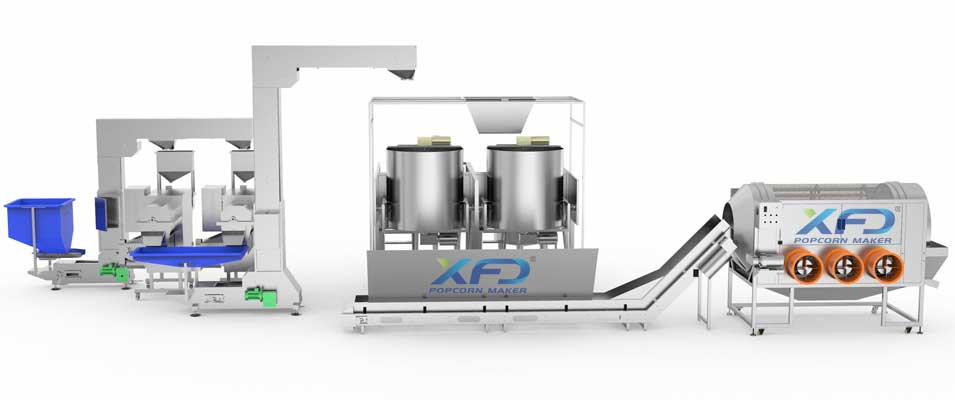
XFD's hot-air popcorn machine and caramelizer production line combines popping and coating equipment for factory production. The manufacturer describes a modular configuration that can be expanded with additional machines and caramelizers to support changing capacity requirements.
For a different production setup, the fully automatic induction popcorn production line uses electromagnetic heating technology and automated ingredient feeding. It is designed for factory applications that need a coordinated popping and flavoring process.
When comparing production lines, ask suppliers to clarify whether the stated capacity refers to uncoated popped popcorn, finished caramel popcorn, or another measurement. These figures are not interchangeable, and actual output depends on the recipe, operating conditions, and selected equipment configuration.
Crispness depends on the moisture content of the finished product, the caramel formulation, coating conditions, cooling, and packaging. Even well-coated popcorn can lose its crisp texture if it absorbs moisture during cooling, storage, or distribution.
The best operating conditions vary by recipe and equipment. Manufacturers should validate cooling time, acceptable moisture levels, and packaging performance through product testing instead of assuming that the same settings will work for every caramel popcorn formulation.
The right equipment configuration depends on the factory's current production needs and future expansion plans. Before selecting a machine or production line, manufacturers should evaluate several practical factors.
A small gourmet popcorn shop and a large snack food factory do not necessarily need the same equipment. Smaller operations may benefit from a compact combined machine, while larger factories may require a complete production and coating line with coordinated feeding and cooling systems.
Manufacturers can review XFD's industrial popcorn machine range to compare production-line options. Sharing the target output, popcorn type, caramel recipe, local electrical requirements, and factory layout with the supplier will make equipment selection more accurate.
How is caramel popcorn made on a commercial scale?
Commercial caramel popcorn is made by popping corn kernels, preparing a caramel coating, mixing the coating with the popcorn, cooling the finished product, and packaging it. Industrial factories may connect these stages with automated feeding, conveying, and coating equipment.
What machine is used to coat popcorn with caramel?
A popcorn caramelizer or industrial cooker and coater is commonly used to prepare or handle the caramel mixture and distribute it across the popcorn. The appropriate machine depends on the recipe, batch size, required output, and production-line design.
Can caramel popcorn be made on a fully automatic production line?
Yes. A suitably configured automated line can connect popping, ingredient feeding, caramel coating, conveying, and cooling. The exact automation level depends on the selected equipment and factory requirements.
How do manufacturers prevent caramel popcorn from becoming sticky?
Manufacturers need to control the caramel formulation and cooking conditions, cool the coated popcorn sufficiently, and use packaging with appropriate moisture-barrier properties. The finished product should be tested under the intended storage and distribution conditions.
What production capacity should a caramel popcorn machine have?
The required capacity depends on sales demand, operating hours, product formulation, and whether the quoted output refers to uncoated popcorn or finished coated popcorn. Manufacturers should compare equipment using the same output basis before making a purchase decision.
What equipment does a caramel popcorn factory need?
A typical factory may need a popcorn popping machine, caramelizer or cooker and coater, ingredient feeding equipment, conveyors, cooling and separating equipment, and packaging machinery. The final configuration depends on the target production volume and desired level of automation.
Commercial caramel popcorn production requires more than a good recipe. Popping performance, caramel preparation, mixing, cooling, and packaging all contribute to the finished product. Selecting compatible equipment helps manufacturers establish a more consistent process and plan for future production requirements.
XFD provides popcorn machines, industrial caramelizers, and integrated popcorn production and coating lines for different commercial applications. Visit the XFD popcorn machinery website to explore the available equipment and contact the team about a production setup suited to your product and capacity requirements.
 No.58 TongMing Road,TongAn District,XiaMen City,FuJian Province
 +86-592-5701935
If you are interested in any XFD product, please leave us a message, we will reply to you soon.
Copyright © 2012-2026 XFD XIAMEN MACHINERY TECHNOLOGY LTD..All Rights Reserved.
 English
 Deutsch
 русский
 español
 português
 Nederlands
 العربية
 हिंदी
हिंदी