Categories
New Blog
Caramel popcorn should have a crisp texture, an even caramel coating, and a sweet, slightly crunchy finish. However, if the popcorn becomes sticky, clumps together, or feels soft instead of crisp, something may have gone wrong during production, cooling, or storage.
Caramel popcorn usually becomes sticky because moisture enters the caramel coating, the caramel has not been cooked properly, or the finished popcorn is packaged before it has cooled sufficiently. The type of ingredients, coating consistency, and storage conditions can also affect the final texture.
For popcorn shops and food manufacturers, identifying the cause is important because sticky caramel popcorn can affect product appearance, packaging performance, shelf life, and customer satisfaction. This guide explains the main causes and practical ways to reduce stickiness, with a focus on commercial caramel popcorn production.
Caramel contains sugar, and sugar readily interacts with moisture. When the coating absorbs water from the surrounding air or remains too moist after cooking, it can become tacky instead of forming a firm, crisp layer.
In commercial production, stickiness is not always caused by a single problem. A batch may leave the caramelizer looking satisfactory but become sticky after cooling or several hours in storage. For this reason, manufacturers should check the entire process rather than changing the recipe immediately.
The most common causes include:
These causes can overlap. For example, caramel that is already slightly soft may become noticeably stickier when the product is stored in a humid room or sealed before cooling is complete.
Moisture is one of the most important factors affecting caramel popcorn texture. A properly prepared caramel coating should develop the texture intended by the recipe as it cools. When the coating absorbs excess moisture, its surface can become tacky, and individual pieces may begin sticking together.
There are two common sources of moisture to consider.
Moisture from the environment: Sugar-based coatings can absorb moisture from humid air. This is particularly important for manufacturers operating in tropical climates, coastal areas, or facilities where humidity is not well controlled.
Moisture retained during processing: If the caramel mixture is not cooked appropriately, or the finished product is handled before it has cooled and stabilized, the coating may not develop the desired crispness.
To reduce these risks, monitor the production environment, follow a consistent caramel recipe, and allow the finished popcorn to cool under suitable conditions. Avoid leaving exposed product in humid areas for longer than necessary.
For factories producing multiple batches, documenting cooking conditions, cooling time, and storage conditions can help identify whether the problem begins during processing or develops later.
Yes. Caramel preparation has a direct influence on the texture of the finished coating. Cooking conditions that are unsuitable for the formulation can result in a coating that remains soft, feels tacky, or does not adhere consistently to the popcorn.
Cooking temperature alone does not tell the whole story. The ingredients, their proportions, heating time, and the amount of moisture in the formulation all influence the final result. A temperature that works for one recipe may not produce the same result with another.
For more consistent production, manufacturers should:
For commercial operations, suitable cooking and mixing equipment can make these conditions easier to control. XFD offers a caramel popcorn cooker and coater designed for coating popcorn with controlled temperature settings and adjustable mixing speed. Its cooling table also supports the cooling stage after coating.
Equipment can help improve process consistency, but the recipe and operating settings still need to be validated for the ingredients and texture requirements of each product.
Cooling is a critical stage in caramel popcorn production. Even when the coating has been prepared correctly, packing the popcorn while it is still warm can create texture problems.
Warm popcorn releases heat into the surrounding air. If it is placed directly into a closed package, moisture may accumulate inside the package, particularly when temperature differences cause condensation. This can soften the caramel coating and reduce the crispness of the popcorn.
To improve cooling results, spread the coated popcorn evenly instead of leaving it in a deep pile. Provide sufficient airflow, prevent unnecessary exposure to humid air, and allow the product to reach an appropriate packaging temperature before sealing.
The exact cooling time depends on batch size, coating thickness, equipment design, airflow, and room conditions. Rather than relying on a fixed time for every batch, establish a repeatable procedure and check the product temperature and texture before packaging.
For small and medium-sized businesses, XFD's popcorn coating equipment category provides options for different coating applications. Choosing equipment that suits the production volume and cooling requirements can help make the coating process more manageable.
Preventing sticky caramel popcorn requires consistent control of the recipe, coating process, cooling stage, and storage environment. The following practices are useful for both small production batches and larger manufacturing operations.
Use a consistent caramel recipe. Measure the ingredients accurately and avoid making uncontrolled changes to sugar, fat, or liquid quantities. Test recipe adjustments in small batches before applying them to regular production.
Control the cooking process. Follow the formulation's recommended cooking conditions. Check the consistency of the caramel mixture and evaluate the coating after it has cooled.
Apply the coating evenly. Uneven coating can create areas with excessive caramel, which may remain tacky or cause popcorn pieces to stick together. Suitable mixing and coating equipment can help distribute caramel more consistently.
Allow sufficient cooling. Do not seal warm popcorn immediately. Use an appropriate cooling procedure to help the coating set before the product enters the packaging stage.
Protect the product from humidity. Keep finished popcorn in a clean, dry environment and minimize unnecessary exposure to humid air. Moisture control matters both during production and after packaging.
Select suitable packaging. Choose food-contact-compliant packaging with moisture-barrier performance appropriate for the product and intended shelf life. The best packaging specification depends on the recipe, storage environment, and distribution conditions.
Check the product after storage. Inspect samples immediately after cooling and again after a defined storage period. This helps determine whether the problem originates in the cooking process or develops during storage.
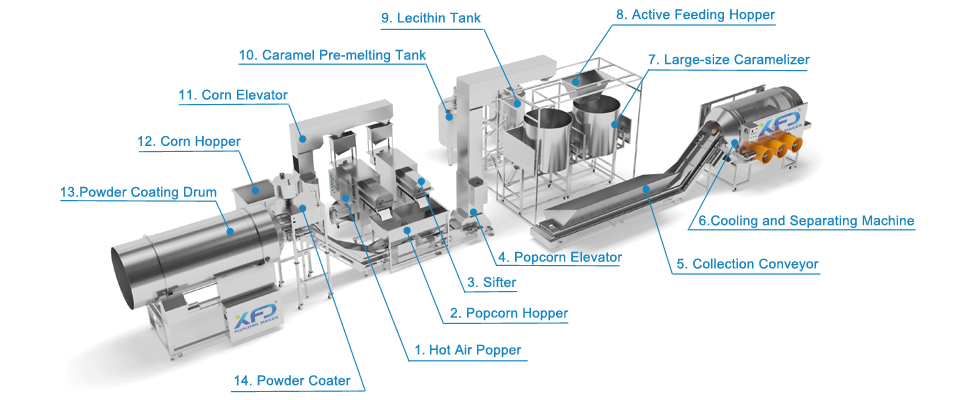
For larger output requirements, an integrated production setup may help coordinate popping, caramel coating, and subsequent handling. XFD's industrial popcorn production and coating line combines hot-air popping equipment with a large caramelizer and coating drum for factory-scale production. Production capacity and configuration should be matched to the manufacturer's actual requirements.
When sticky caramel popcorn appears during production, a structured troubleshooting process is more effective than changing several variables at once.
A simple troubleshooting record can include the batch number, recipe, cooking conditions, cooling time, packaging time, room humidity, and texture observations. Over time, these records can help manufacturers establish more reliable production standards.
For factories scaling up production, XFD's industrial popcorn machine range includes production solutions designed for higher-volume operations. The appropriate configuration depends on the desired output, flavor range, available space, and degree of automation.
Why does caramel popcorn become sticky after a few hours?
Caramel popcorn may become sticky after a few hours because the sugar coating absorbs moisture from humid air, the coating retains excess moisture, or the product is packaged before it has cooled sufficiently. Check the product's cooling, packaging, and storage conditions to identify the likely cause.
Can you fix sticky caramel popcorn?
If the popcorn is only slightly tacky and has been handled and stored safely, controlled drying or reheating may improve its texture, depending on the recipe. However, reheating is not a universal solution and may burn the caramel. Discard products that show signs of spoilage or have been stored under unsafe conditions.
Does humidity make caramel popcorn sticky?
Yes. Sugar-based caramel coatings can absorb moisture from humid air, making the surface tacky and causing popcorn pieces to clump together. Keeping the production and storage environment dry and using suitable moisture-barrier packaging can help reduce this problem.
Should caramel popcorn cool before packaging?
Yes. Caramel popcorn should cool to an appropriate packaging temperature before it is sealed. Packaging warm popcorn can trap heat and moisture, potentially softening the coating and reducing crispness.
What equipment helps reduce sticky caramel popcorn in commercial production?
A suitable caramelizer or cooker and coater can help control heating, mixing, and coating consistency. Cooling equipment and a well-planned packaging process are also important. Equipment selection should reflect the recipe, production capacity, and desired finished-product texture.
How can manufacturers keep caramel popcorn crispy for longer?
Manufacturers should use a validated recipe, control caramel cooking, cool the product properly, minimize humidity exposure, and select packaging with an appropriate moisture barrier. Shelf-life testing under the intended storage conditions is necessary to confirm how long the product maintains its desired texture.
Caramel popcorn becomes sticky mainly because of moisture absorption, unsuitable caramel cooking conditions, incomplete cooling, or inadequate packaging. The most effective solution is to identify where the texture begins to deteriorate and correct that stage of the process.
For commercial popcorn manufacturers, consistent recipes, controlled coating, proper cooling, and moisture-resistant packaging all contribute to a more reliable finished product. With suitable equipment and documented production procedures, businesses can improve batch consistency and reduce avoidable texture problems.
XFD provides popcorn machines and production equipment for commercial and industrial applications, including caramelizers, coating systems, and integrated production lines. Manufacturers can explore the available solutions to find equipment that fits their production process and output requirements.
 No.58 TongMing Road,TongAn District,XiaMen City,FuJian Province
 +86-592-5701935
If you are interested in any XFD product, please leave us a message, we will reply to you soon.
Copyright © 2012-2026 XFD XIAMEN MACHINERY TECHNOLOGY LTD..All Rights Reserved.
 English
 Deutsch
 русский
 español
 português
 Nederlands
 العربية
 हिंदी
हिंदी