Categories
New Blog
Keeping caramel popcorn crispy requires more than a good recipe. The caramel must be cooked to the right consistency, distributed evenly over the popcorn, and allowed to cool before the product is packed. Moisture control is equally important because caramel popcorn can become sticky or lose its crunch when it absorbs moisture from the surrounding air.
For popcorn shops, snack brands, and commercial food manufacturers, consistent crispness also depends on the production process and packaging conditions. XFD Popcorn provides commercial and industrial popcorn equipment designed to support popping, caramel coating, and larger-scale production. Understanding how each stage affects texture can help manufacturers produce caramel popcorn with a more consistent finish and better storage performance.
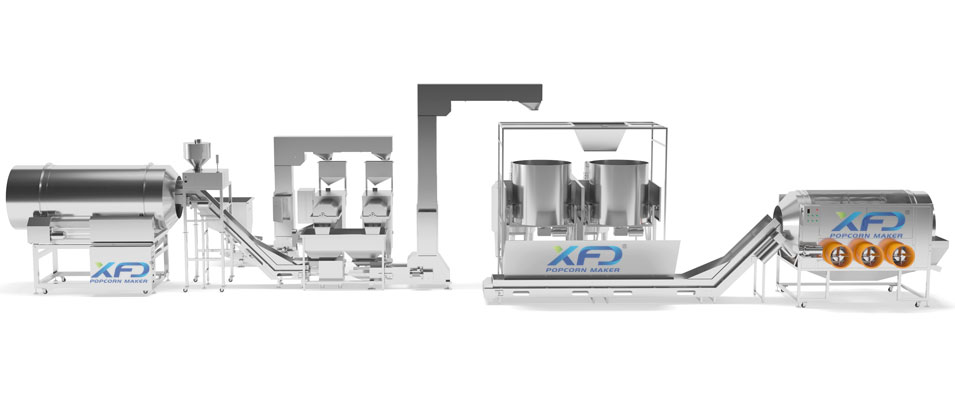
Caramel popcorn usually becomes soft for one of four reasons: moisture exposure, an unsuitable caramel coating, insufficient cooling, or packaging that does not provide adequate protection. Identifying the cause is the first step toward improving the finished product.
Moisture absorption: Popcorn has a porous structure, and its crisp texture is sensitive to moisture. When the finished product is exposed to humid air, it can gradually become less crunchy. Caramel coatings can also become sticky when moisture affects the sugar layer.
Incorrect caramel preparation: If the caramel mixture contains too much residual moisture or is not cooked consistently, the coating may remain soft instead of forming the intended crisp layer. Cooking conditions must be matched to the recipe and production process.
Uneven coating: Thick caramel deposits can remain sticky in some areas while other kernels have too little coating. Uniform distribution helps create a more consistent texture throughout the batch.
Premature packaging: Packing caramel popcorn before it has cooled sufficiently can trap residual heat and moisture. This may cause condensation inside the package and reduce crispness during storage.
For commercial producers, these issues should be evaluated together rather than treated as separate problems. The coating process, cooling conditions, and package performance all influence the final result.
The caramel cooking stage has a direct effect on the texture of caramel popcorn. Sugar concentration, cooking temperature, cooking time, and the ingredients used all influence how the coating behaves after it cools.
A caramel mixture that has not been cooked sufficiently may retain too much moisture, leaving the finished popcorn tacky. Excessive heating, on the other hand, can cause burnt flavors, dark coloration, and inconsistent product quality.
Manufacturers should establish a repeatable cooking procedure for each formulation. Temperature readings, cooking time, ingredient ratios, and the final texture should be checked during production. Because recipes differ, there is no single cooking temperature that guarantees crispy caramel popcorn for every product.
For larger batches, an industrial cooker and coater can help operators manage heating and mixing more consistently. XFD's Industrial Popcorn Cooker and Coater combines caramel cooking and mixing, with adjustable digital temperature control to support recipe-specific processing.
Even caramel distribution is essential for consistent flavor and texture. When caramel gathers in thick clumps, the coating may stay sticky in those areas, while lightly coated kernels may taste less sweet or lack the desired finish.
During production, the popcorn should be mixed thoroughly enough for the caramel to reach the surface of the kernels without excessive breakage. Mixing speed, batch size, caramel flow, and equipment design should be adjusted to suit the recipe and the condition of the popcorn.
Manual mixing may be suitable for very small batches, but it becomes harder to maintain uniform results as output increases. A dedicated caramelizer or cooker-and-coater helps combine heating and mixing in a controlled process.
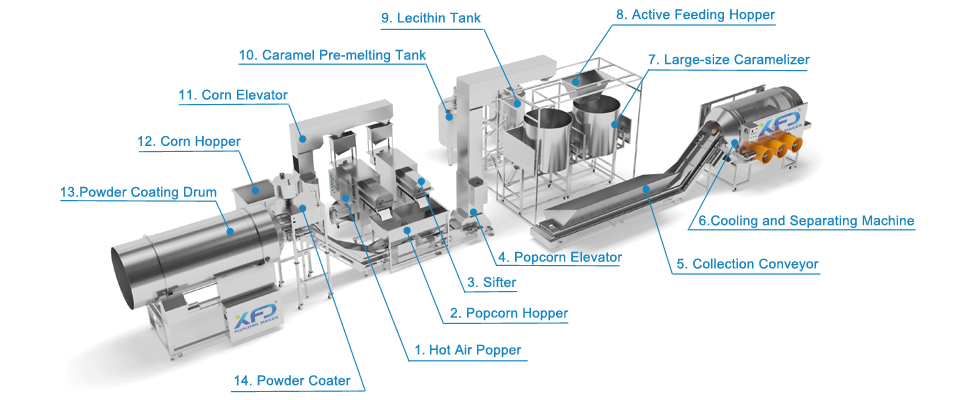
Businesses comparing equipment options can explore XFD's popcorn coating machines. The suitable machine depends on production volume, the coating formulation, mixing requirements, and the number of flavors being produced.
Even coating does not automatically guarantee long-lasting crispness, but it makes the finished product easier to standardize and helps reduce batch-to-batch differences.
After caramel coating, allow the popcorn to cool under clean, controlled conditions before sealing it in a package. The cooling stage allows the caramel layer to set and helps prevent excess heat and moisture from being trapped inside the packaging.
Cooling time depends on batch size, coating thickness, airflow, room conditions, and the recipe. Instead of relying only on a fixed waiting time, manufacturers should validate the cooling process and confirm that the popcorn is sufficiently cool and the coating has reached the intended texture before packing.
Keep the cooling area clean and avoid unnecessary exposure to humid air. At the same time, do not place hot popcorn directly into a tightly sealed package simply to speed up production. Condensation can undermine the texture that the cooking and coating stages were designed to achieve.
For commercial operations, the cooling stage should be planned as part of the overall production workflow. If the coating equipment produces popcorn faster than the cooling and packing stages can handle, the resulting bottleneck may affect product consistency and packaging efficiency.
Even perfectly cooked and cooled caramel popcorn can lose its crunch if the package allows too much moisture to enter. Packaging is therefore one of the most important factors in maintaining texture during storage, transportation, and retail display.
When choosing packaging, manufacturers should consider the following factors:
There is no universal shelf life for caramel popcorn. The result depends on the recipe, initial moisture level, packaging material, seal quality, and storage environment. Manufacturers should confirm shelf life through product-specific testing rather than relying on packaging type alone.
For businesses expanding into packaged popcorn, XFD offers popcorn production and equipment solutions that can be evaluated as part of a wider manufacturing workflow. Packaging equipment should be selected according to the required bag format, output rate, and sealing specifications.
As production volume grows, keeping caramel popcorn crispy becomes a process-control challenge. Operators need to coordinate popping, caramel preparation, coating, cooling, and packaging rather than focusing on one machine alone.
Small popcorn shops may benefit from compact equipment that combines popping and caramelizing in one setup. Larger manufacturers may need dedicated cooking and coating equipment, integrated production lines, and a packaging process that matches the output of the upstream machinery.
XFD's Cooker and Coater Seasoning Machine is designed for caramel coating applications, with mixing baffles and adjustable digital temperature control. These features can help operators manage coating consistency when the machine is correctly configured for the recipe.
For factory-scale production, XFD also offers an industrial caramelizer for popcorn with automated feeding and recipe-dependent temperature adjustment. Equipment selection should take account of batch size, output targets, cleaning requirements, and the downstream cooling and packing capacity.
The goal is not simply to produce more popcorn per hour. A reliable production process should also deliver even coating, repeatable flavor, manageable moisture levels, and a finished product that meets the brand's texture and shelf-life requirements.
A practical quality-control program should evaluate the product at more than one point in the process. Checking freshly coated popcorn alone cannot show whether the product will remain crisp after packaging and storage.
Manufacturers can establish a simple testing routine:
Where possible, use a consistent evaluation method and record the results for each batch. If crispness declines, compare the records for caramel cooking, cooling conditions, packaging materials, and storage environment to identify the most likely cause.
This approach helps businesses move beyond guesswork. It also provides more reliable information when adjusting recipes, selecting machinery, or setting a product's shelf life.
To keep caramel popcorn crispy, manufacturers need to control caramel cooking, apply an even coating, cool the product adequately, and protect it from moisture through suitable packaging and storage. Each step contributes to the final texture, and a weakness in one stage can affect the entire batch.
For commercial popcorn shops and industrial snack manufacturers, the right equipment can make these steps easier to standardize. XFD Popcorn provides popcorn popping, caramelizing, coating, and production equipment for businesses with different output requirements.
If you are planning to improve caramel popcorn quality or scale up production, review the XFD popcorn coating equipment range and compare the available options with your recipe, target capacity, cooling process, and packaging requirements.
Cook the caramel to the correct consistency, coat the popcorn evenly, let it cool before packaging, and use moisture-resistant packaging with reliable seals. Store the finished product in a cool, dry environment.
Common causes include moisture absorption, caramel that retains too much moisture, uneven coating, and packaging that traps heat or allows moisture to enter. Check the cooking, cooling, and storage conditions to identify the cause.
Yes. Caramel popcorn should cool sufficiently for the coating to set before it is packed. Sealing the product while it is still hot can trap heat and moisture, potentially causing condensation and a softer texture.
Packaging with a suitable moisture barrier and reliable seals helps protect caramel popcorn from humidity. The best material depends on the product formulation, storage conditions, and intended shelf life, so packaging tests are recommended.
The right equipment depends on the production volume and process. Small businesses may consider a compact popper-and-caramelizer combination, while larger factories may need an industrial cooker and coater or an integrated production line. XFD provides options for different commercial and industrial applications.
It can maintain acceptable crispness for a product-specific period when the recipe, cooking process, cooling conditions, packaging, and storage environment are properly controlled. The actual shelf life should be confirmed through testing under the intended storage conditions.
 No.58 TongMing Road,TongAn District,XiaMen City,FuJian Province
 +86-592-5701935
If you are interested in any XFD product, please leave us a message, we will reply to you soon.
Copyright © 2012-2026 XFD XIAMEN MACHINERY TECHNOLOGY LTD..All Rights Reserved.
 English
 Deutsch
 русский
 español
 português
 Nederlands
 العربية
 हिंदी
हिंदी