Categories
New Blog
Launching a new flavored popcorn product involves much more than developing an interesting flavor. Before introducing a new product to the market, manufacturers need to confirm that the recipe tastes right, the coating performs well, the popcorn maintains its texture, and the entire production process can deliver consistent results at commercial scale.
A flavor that works perfectly in a small kitchen trial may behave differently in an industrial production environment. Seasoning may distribute unevenly, caramel may become too thick, certain ingredients may affect popcorn crispness, or the finished product may lose its flavor during storage.
For popcorn manufacturers, snack food brands, and food processing companies, product testing should cover the entire process, from ingredient selection and recipe development to equipment compatibility, production stability, and packaging performance.
So, what should manufacturers test before launching a new flavored popcorn product? This guide explains the essential testing stages and how suitable popcorn production and coating equipment can help turn a promising recipe into a commercially viable product.
New popcorn flavors often look attractive during initial development, but a successful product must meet more than taste expectations. It needs to perform consistently during manufacturing, transportation, storage, and actual consumption.
For example, a manufacturer developing strawberry-flavored popcorn may find that the first trial has an appealing color and fruity taste. However, further testing may reveal that the coating is too sticky, the seasoning distribution is uneven, or the flavor becomes weaker after several weeks of storage.
Without sufficient testing, these problems may only become apparent after commercial production has started.
Pre-launch product testing helps manufacturers:
In other words, product testing connects recipe development with actual manufacturing requirements. It helps manufacturers understand not only whether a flavor is appealing, but also whether it can be produced reliably and economically.
The first test should focus on the flavor itself. A new popcorn product needs a recognizable and appealing taste that matches its intended market positioning.
Manufacturers should evaluate several sensory characteristics rather than judging a product based on taste alone.
Sweetness and saltiness
For caramel, strawberry, chocolate, and other sweet popcorn varieties, manufacturers should determine whether the sweetness is balanced. Excessive sweetness may overpower the popcorn's natural flavor, while insufficient seasoning may make the product taste weak.
For cheese, barbecue, spicy, and savory flavors, saltiness and seasoning intensity need similar attention.
Flavor intensity and aroma
The aroma should match the intended flavor. For example, strawberry popcorn should have a recognizable fruity character without an unpleasant artificial aftertaste. Chocolate popcorn should deliver a balanced chocolate profile rather than simply tasting excessively sweet.
Aftertaste
Some flavoring ingredients may leave a lingering taste after consumption. Manufacturers should evaluate whether the aftertaste is pleasant and consistent with the product's positioning.
Overall consumer preference
It is useful to conduct sensory evaluations with people who represent the intended customer group. Manufacturers can compare several recipe variations and collect feedback about flavor preference, sweetness, aroma, texture, and overall acceptance.
Rather than asking only whether someone likes the popcorn, use a consistent evaluation method to identify which characteristics need improvement.
For example, a manufacturer developing a new strawberry popcorn product can compare different coating concentrations and determine which version provides the best balance between fruity flavor, sweetness, and popcorn texture.

Strawberry popcorn and coating sugar for flavored popcorn product development.
XFD offers different strawberry popcorn coating sugar options, providing a practical reference for manufacturers exploring fruit-flavored popcorn products.
After confirming the basic flavor profile, manufacturers need to test how the seasoning or coating performs on actual popcorn.
A seasoning formula may taste excellent when sampled separately, but its performance can change when applied to popcorn. Factors such as particle size, coating viscosity, moisture content, application method, and mixing conditions can affect the final result.
The testing method should depend on the type of flavoring material.
Dry seasoning powders
Cheese, barbecue, seaweed, spicy, and other savory popcorn products commonly use dry seasoning powders.
Manufacturers should check:
Liquid and cooked coatings
Caramel, chocolate, and other liquid-based coatings require additional attention to viscosity, temperature, and mixing performance.
Manufacturers should evaluate whether the coating flows properly, covers the popcorn evenly, and develops the intended texture after cooling.
For example, caramel that is too thick may form uneven clusters, while an unsuitable coating process may leave some popcorn pieces insufficiently covered.
Coating uniformity
Regardless of the flavor type, manufacturers should inspect samples from different areas of the finished batch. Checking only a few attractive pieces may not reveal uneven seasoning distribution.
For more controlled coating trials, a popcorn coater mixer tumbler can help manufacturers evaluate different powder and liquid coating formulas.
XFD's CM-400 coater mixer tumbler uses a rotating, removable bowl for coating applications. Its product specifications list a 5-gallon capacity and support for powder or liquid coating, making it a useful equipment option to consider for flavor development and smaller-scale coating trials.
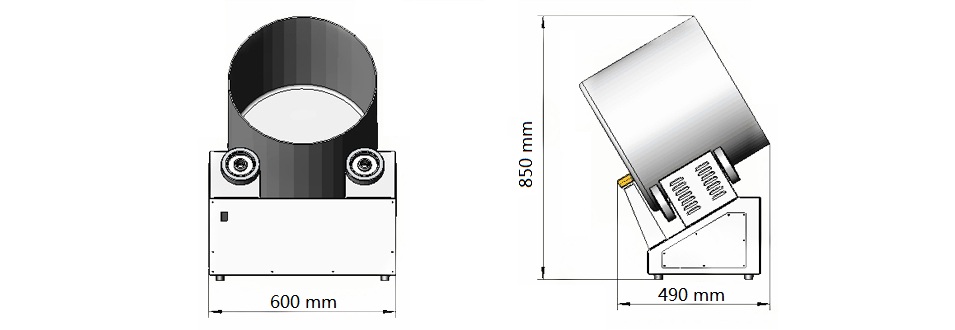
XFD coater mixer tumbler for popcorn seasoning and coating trials.
A successful new flavor should not compromise the basic eating experience of popcorn.
Even when the seasoning tastes excellent, consumers may reject a product that feels soggy, excessively hard, sticky, or difficult to eat.
Manufacturers should evaluate the following physical characteristics.
Crispness
Check whether the popcorn maintains its crisp texture immediately after production and after the intended storage period. Coating ingredients and moisture exposure can influence the finished product's texture.
Coating thickness
For caramel, chocolate, and other coated popcorn products, examine whether the coating is evenly distributed without making the popcorn excessively heavy or sticky.
Color consistency
Compare the finished product with an approved color reference. Different heating conditions, coating concentrations, and seasoning quantities may affect the appearance of the final product.
Popcorn integrity
Check the percentage of broken pieces, unpopped kernels, and excessive clusters. Mixing and conveying operations should not create unnecessary product damage.
Surface condition
Look for powder accumulation, sticky patches, uneven coating, or visible separation of ingredients.
These tests are particularly important for premium flavored popcorn, where product appearance often influences consumer expectations before the first bite.
One of the most important steps before launching a new popcorn product is confirming that the recipe works outside the laboratory or small-batch development environment.
A formula that performs well in a small mixing bowl may behave differently when processed through industrial popping, coating, and conveying equipment.
Manufacturers should therefore conduct pilot production trials using equipment and operating conditions that closely represent the intended commercial production process.
Important factors to evaluate include:
Manufacturers should also compare the first production batch with subsequent batches. A successful pilot should demonstrate that the product can be reproduced under the same approved operating conditions.
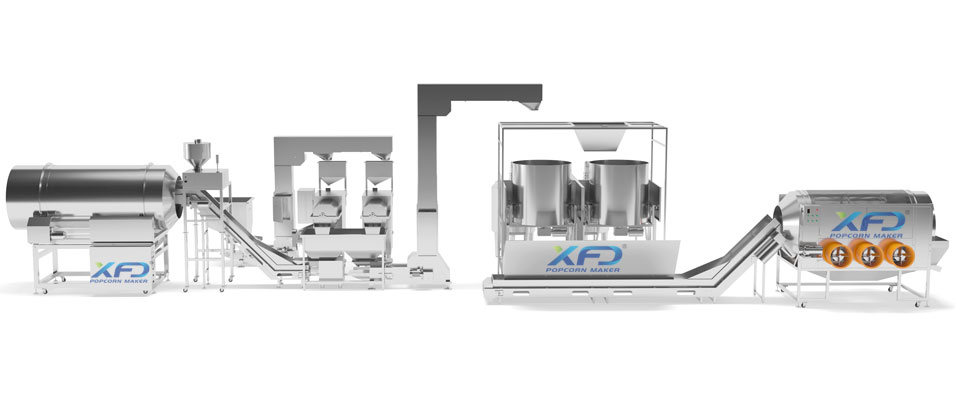
Industrial popcorn production and coating equipment for commercial-scale trials.
For manufacturers planning to move from pilot trials to larger production volumes, XFD's industrial popcorn production and coating line provides an integrated equipment configuration for popping, conveying, cooling, and coating.
The listed system includes electromagnetic popcorn machines, an oil supply system, conveyors, and cooling and filtering equipment. Its configuration can help manufacturers evaluate how different production stages work together when developing new flavored popcorn products.
A new popcorn flavor should taste good not only immediately after production but also throughout its intended shelf life.
Seasoning ingredients, coating materials, moisture, oxygen exposure, and packaging conditions can all influence product stability.
Manufacturers should conduct shelf-life testing using the actual packaging format intended for commercial distribution.
Key evaluation points include:
Accelerated shelf-life studies may help identify potential stability problems, but they should not automatically replace real-time shelf-life validation. Manufacturers should establish testing conditions based on the ingredients, packaging, storage environment, and applicable food safety requirements.
Where necessary, manufacturers should also conduct appropriate microbiological, chemical, and packaging-related safety tests through qualified laboratories.
Packaging is another important part of new flavored popcorn product development. Even a well-formulated popcorn product may lose quality if the packaging cannot protect it during storage and transportation.
Different popcorn flavors may have different packaging requirements. For example, products with sticky caramel coatings may require additional attention to product separation, while flavored popcorn with delicate seasoning may need packaging that limits powder loss and protects the product from moisture.
Before launch, manufacturers should evaluate:
Manufacturers should also conduct practical packaging trials rather than evaluating packaging materials only from their technical specifications.
For example, filled packages can be inspected after sealing and subjected to appropriate handling and transportation simulations. This helps identify leakage, broken popcorn, coating transfer, and other potential problems before the product reaches distributors or retailers.
Not every popcorn recipe is suitable for every production configuration. The coating ingredients, product texture, batch size, and required output all influence equipment selection.
Before scaling up a new flavored popcorn product, manufacturers should evaluate whether their existing equipment can support the recipe efficiently.
For dry seasoning applications, a coating tumbler needs to provide sufficient mixing action to distribute powder without causing excessive breakage.
For caramel and chocolate popcorn, the coating process may require heating, controlled ingredient feeding, and suitable mixing equipment to handle the coating material.
For larger factories, an integrated production line may be more suitable than several independent machines, particularly when production involves continuous conveying, cooling, and coating stages.
XFD provides different equipment solutions for popcorn manufacturers, including:
For example, XFD's industrial hot-air popcorn production line combines hot-air popping, coating, and caramelizing equipment. The product configuration includes adjustable digital temperature controls and a modular design, which are relevant considerations when planning production around different product requirements.
The best equipment configuration depends on the flavor formula, target production capacity, coating characteristics, and factory workflow. Manufacturers should discuss these factors with the equipment supplier before making a final investment decision.
To make product development more organized, manufacturers can use a standardized testing checklist before approving a new flavored popcorn product.
The following table summarizes the main testing areas and what should be evaluated.
| Testing Area | Key Evaluation Points | Purpose |
|---|---|---|
| Flavor testing | Sweetness, saltiness, aroma, aftertaste | Confirm consumer acceptance |
| Coating testing | Adhesion, coverage, powder loss, viscosity | Check seasoning performance |
| Texture testing | Crispness, hardness, stickiness, breakage | Maintain product quality |
| Production testing | Temperature, mixing, feeding, output | Verify manufacturing feasibility |
| Shelf-life testing | Flavor, aroma, moisture, texture | Evaluate storage stability |
| Packaging testing | Sealing, barrier performance, transportation | Protect the finished product |
| Safety testing | Ingredient compliance, allergens, microbiological requirements | Support regulatory compliance |
Manufacturers should establish acceptance criteria for each testing area before conducting trials. This makes it easier to compare different formulas, identify problems, and decide whether a product is ready for commercial production.
A new popcorn flavor should move into commercial production only after the key product and manufacturing requirements have been validated.
Before launch, manufacturers should be able to confirm that:
It is also important to document the approved recipe, equipment settings, ingredient specifications, and quality inspection procedures. These records provide a reference for future production batches and help maintain consistency when output increases.
Launching a new flavor should be treated as a complete product validation process rather than simply approving a successful sample.
Developing a new flavored popcorn product requires coordination between the recipe, seasoning method, processing conditions, and production equipment.
As a specialized popcorn equipment manufacturer, XFD provides equipment solutions for commercial and industrial popcorn production, including popping machines, coating equipment, caramelizers, cooling systems, and integrated production lines.
For manufacturers exploring new product varieties, equipment selection should be based on the intended flavor, coating type, production volume, and level of automation required.
Whether you are developing strawberry popcorn, caramel popcorn, cheese popcorn, chocolate popcorn, or other specialty snack products, the right production configuration can help support recipe trials and future manufacturing requirements.
XFD's equipment portfolio covers different production needs, from individual coating machines to integrated industrial popcorn production systems.
If you are planning to introduce a new flavored popcorn product or expand your existing production capacity, contact XFD to discuss your processing requirements and explore suitable equipment solutions.
What should manufacturers test before launching a new flavored popcorn product?
Manufacturers should test flavor acceptance, seasoning adhesion, coating uniformity, popcorn texture, production performance, shelf-life stability, packaging compatibility, and food safety requirements. These tests help confirm that the product is suitable for commercial manufacturing and distribution.
How do you test a new popcorn flavor before mass production?
Start with small-batch recipe trials, compare different seasoning concentrations, and conduct sensory evaluations. Then test the selected formula using suitable production equipment to check coating performance, texture, processing conditions, and batch consistency before increasing production volume.
Why is coating uniformity important for flavored popcorn?
Coating uniformity determines whether popcorn pieces receive a consistent amount of seasoning or coating. Uneven distribution can result in some pieces tasting too strong while others have very little flavor. Suitable coating equipment and controlled mixing conditions help improve distribution.
How can manufacturers test whether popcorn stays crispy after packaging?
Manufacturers should package popcorn using the intended commercial packaging material and evaluate the product under defined storage conditions. Testing should include texture, moisture changes, flavor retention, seal performance, and appearance over the intended shelf-life period.
What equipment is suitable for testing different popcorn flavors?
Coater mixer tumblers are useful for testing dry seasoning powders and certain liquid coatings. Caramelizers are suitable for cooked coatings, while industrial popcorn production lines can help manufacturers evaluate complete production workflows at larger volumes. Equipment selection depends on the recipe and production requirements.
Can the same popcorn production line produce different flavors?
Yes. A suitably configured popcorn production line can support different flavors, including caramel, chocolate, strawberry, cheese, and other varieties. However, manufacturers may need to adjust ingredient ratios, coating conditions, mixing parameters, and cleaning procedures between production runs.
How long should manufacturers test a new popcorn product before launch?
There is no universal testing period. The required time depends on recipe complexity, pilot production results, shelf-life requirements, packaging validation, and applicable food safety regulations. Manufacturers should complete the necessary tests and document their results before approving commercial production.
What is the biggest mistake when developing a new flavored popcorn product?
One common mistake is evaluating only the initial taste without testing production performance and storage stability. A successful product must maintain acceptable flavor, texture, coating quality, and consistency under actual manufacturing and distribution conditions.
 No.58 TongMing Road,TongAn District,XiaMen City,FuJian Province
 +86-592-5701935
If you are interested in any XFD product, please leave us a message, we will reply to you soon.
Copyright © 2012-2026 XFD XIAMEN MACHINERY TECHNOLOGY LTD..All Rights Reserved.
 English
 Deutsch
 русский
 español
 português
 Nederlands
 العربية
 हिंदी