Categories
New Blog
For popcorn manufacturers, producing a great-tasting batch is only part of the challenge. The real challenge is making sure that every batch delivers the same flavor, aroma, color, texture, and coating quality. Whether a factory produces caramel popcorn, cheese popcorn, chocolate popcorn, or traditional butter popcorn, customers expect the product they purchase today to taste just like the one they purchased last time.
However, maintaining consistent popcorn flavor across multiple production batches can be difficult. Variations in kernel quality, ingredient ratios, heating conditions, coating temperature, mixing time, and equipment performance can all affect the final product.
For commercial popcorn manufacturers, flavor consistency requires more than a standardized recipe. It depends on controlling the entire production process, from raw material preparation and popping to seasoning, coating, cooling, and packaging.
This guide explains how popcorn producers can improve flavor consistency across production batches, reduce product variation, and build a more reliable manufacturing process with suitable popcorn production equipment.
Flavor consistency directly affects customer satisfaction, brand reputation, and product quality. When consumers purchase the same popcorn product repeatedly, they expect a familiar taste and eating experience.
For example, a caramel popcorn brand should maintain a similar sweetness level, caramel color, and coating thickness across different production runs. Likewise, cheese popcorn should deliver a consistent savory flavor without some batches tasting noticeably saltier or more heavily seasoned than others.
Inconsistent production can create several problems:
For popcorn factories supplying supermarkets, distributors, private-label brands, and international snack markets, establishing repeatable production standards is essential for maintaining product quality as production volume increases.
Before improving flavor consistency, manufacturers need to understand where production variations originate. In many cases, the problem is not caused by a single machine or ingredient. Instead, several small variations can combine to affect the finished popcorn.
Raw material differences
Popcorn kernels, cooking oil, sugar, salt, and seasoning powders all influence the final flavor. Differences in kernel moisture, ingredient quality, seasoning concentration, and storage conditions can affect how ingredients perform during production.
For example, kernels with different moisture characteristics may produce popcorn with different expansion results and surface conditions. This can influence how evenly caramel or seasoning adheres to the finished product.
Inaccurate ingredient measurement
Using slightly different amounts of oil, sugar, salt, or flavoring ingredients in each batch can change the final taste. Manual ingredient addition makes this particularly difficult when production volumes increase.
Unstable heating conditions
Temperature variations during popping and caramel preparation can affect product color, aroma, and texture. Excessive heating may cause undesirable burnt flavors, while insufficient heating can affect popping performance or coating development.
Inconsistent mixing and coating
Even when the recipe is correct, inconsistent mixing speed, processing time, or ingredient feeding can result in uneven flavor distribution. This is especially important for factories producing caramel, cheese, chocolate, and other coated popcorn varieties.
Different cooling and handling conditions
After seasoning or coating, popcorn needs appropriate cooling and handling before packaging. Delays, excessive handling, or unsuitable storage conditions may affect crispness and the overall eating experience.
One of the most effective ways to improve popcorn flavor consistency is to establish a standardized production recipe for each flavor.
Rather than relying on operators to estimate ingredient quantities, manufacturers should define measurable ingredient ratios and document the preparation procedure.
A standardized recipe should include:
For example, a caramel popcorn manufacturer should establish a consistent relationship between popcorn input, sugar, oil, and other coating ingredients. The exact ratio should be determined through product testing and adjusted according to the recipe and equipment configuration.
Manufacturers should also create separate recipes for different flavors. A caramel popcorn recipe should not be treated as interchangeable with a cheese or strawberry popcorn formula because different ingredients have different processing requirements.
Most importantly, every production batch should follow the same approved recipe unless a documented adjustment is required.
Consistent popping conditions provide the foundation for consistent popcorn quality. If the popping stage produces kernels with significantly different expansion, texture, or surface conditions, subsequent seasoning and coating processes may also become less predictable.
Manufacturers should pay attention to several operating factors:
For larger manufacturing operations, equipment selection also influences process repeatability. Industrial popcorn machines can be configured for different production requirements, including electromagnetic and hot-air popping systems.
Electromagnetic popcorn equipment is particularly worth considering for factories looking to organize repeatable batch production. XFD's industrial electromagnetic production solutions are designed to integrate popping with other processing stages, depending on the selected configuration.
However, manufacturers should not assume that changing to an automatic machine alone will solve every flavor problem. The recipe, raw materials, operating parameters, and downstream processing conditions must also be controlled.
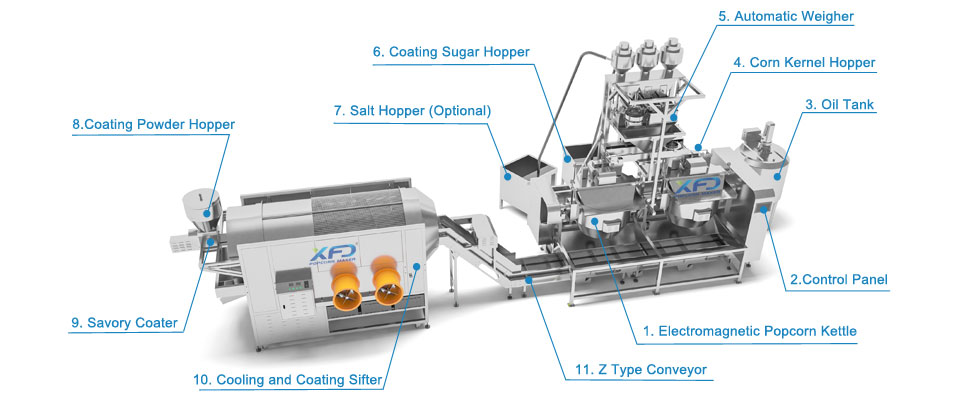
XFD industrial electromagnetic popcorn production and coating equipment.
For flavored popcorn manufacturers, seasoning and coating are among the most important stages for maintaining consistent taste.
Even when every batch uses the same ingredients, uneven application can make the finished product taste different from one piece to another. Some pieces may be excessively sweet or salty, while others may have insufficient flavor.
The appropriate coating process depends on the finished product.
Dry seasoning applications
Cheese, barbecue, butter, and other savory popcorn products commonly use dry seasoning powders. Manufacturers need to control powder feeding, mixing conditions, and the amount of seasoning applied to the popcorn.
A suitable rotating coating drum or tumbler helps distribute seasoning through continuous product movement. The mixing process should provide sufficient contact without excessive agitation that could damage the popcorn.
Liquid coating applications
Caramel, chocolate, and other liquid-coated popcorn products require closer attention to coating temperature, ingredient feeding, and mixing conditions.
If the coating material is too thick or too thin, its distribution may become inconsistent. Changes in cooking temperature and mixing time can also influence coating texture and appearance.
For these applications, manufacturers should choose equipment according to the coating ingredients, required processing capacity, and desired finished-product characteristics.
XFD provides different popcorn coating and seasoning machines, including caramelizers, coating drums, and tumbler-style equipment for different flavored popcorn applications.

Integrated popcorn production and caramel coating equipment.
For factories producing multiple flavors, equipment that supports practical recipe adjustments and manageable cleaning procedures can also help reduce cross-flavor contamination and improve production changeovers.
Ingredient ratios are important, but the way ingredients interact with popcorn during processing is equally important.
Mixing time and coating temperature should be established for each product formula instead of using identical settings for every flavor.
For example, caramel popcorn requires an appropriate combination of coating temperature, syrup consistency, and mixing conditions to achieve even coverage. If mixing is insufficient, some popcorn pieces may remain undercoated. Excessive mixing may increase product breakage.
For dry-seasoned popcorn, the objective is to distribute seasoning evenly while maintaining the desired surface texture.
Manufacturers can improve process control by following these practices:
It is important to remember that there is no universal mixing time or coating temperature suitable for every popcorn recipe. These parameters should be validated through actual production trials and adjusted according to the ingredients and equipment used.
Flavor consistency does not end when seasoning or coating is completed. Cooling and handling also influence the final product quality.
For caramel and chocolate popcorn, appropriate cooling helps the coating set before further handling and packaging. If products are transferred too early or remain in unsuitable conditions, coating appearance and texture may be affected.
For savory popcorn, excessive exposure to moisture during storage and handling can reduce crispness and change the overall eating experience.
Manufacturers should consider the following:
For high-volume manufacturing, cooling, separating, and conveying equipment should be matched to the production capacity of the popping and coating stages. A bottleneck in any of these areas can interrupt the entire production workflow.
Standardized recipes and suitable equipment provide a good starting point, but manufacturers still need a reliable way to determine whether production is consistent.
A practical batch quality record allows operators to identify variations and understand where problems originate.
For each production batch, manufacturers can record the following information:
| Quality Indicator | What to Monitor |
|---|---|
| Raw materials | Kernel variety, moisture, ingredient quality, and storage conditions. |
| Ingredient ratios | Kernel, oil, sugar, salt, and seasoning quantities. |
| Popping conditions | Heating settings, cycle time, and unpopped kernel rate. |
| Coating conditions | Coating temperature, ingredient feeding, and mixing time. |
| Finished product | Flavor, color, coating uniformity, texture, and product breakage. |
| Production performance | Output, downtime, rejected products, and material consumption. |
For example, if the third batch of caramel popcorn has a darker color and stronger caramel taste than the previous batches, production records can help identify whether the difference comes from heating conditions, ingredient ratios, or coating time.
Manufacturers should also retain approved reference samples or documented quality specifications where practical. Comparing new production batches against these standards makes quality evaluation more objective.
As popcorn production expands, controlling each processing stage independently can become increasingly difficult. Manual ingredient feeding, separate processing equipment, and frequent product transfers may introduce additional variations.
An integrated popcorn production line can help manufacturers coordinate the main stages of production, including:
By coordinating these stages, manufacturers can establish a more repeatable workflow and reduce unnecessary manual handling.
XFD offers different industrial popcorn production and coating lines for factories producing different popcorn varieties and output volumes.
Depending on the selected configuration, production systems can incorporate electromagnetic popping, hot-air popping, caramelizing, coating, cooling, and other processing equipment.
When selecting a production line, manufacturers should evaluate more than rated hourly capacity. They should also consider flavor requirements, ingredient feeding accuracy, coating performance, cleaning procedures, production flexibility, and the capacity of downstream equipment.
A suitable production configuration should support both the factory's current production requirements and its future product development plans.
Before starting a new production run, manufacturers can use the following checklist to reduce unnecessary variations between batches.
Following a consistent operating procedure makes it easier to identify problems early and maintain similar product characteristics across multiple production runs.
Improving popcorn flavor consistency requires coordination between raw materials, processing conditions, seasoning methods, and production equipment.
As a popcorn equipment manufacturer, XFD provides solutions for commercial and industrial popcorn production, including electromagnetic popcorn machines, hot-air popping systems, caramelizers, coating equipment, cooling systems, and integrated production lines.
Different equipment configurations can be considered according to the factory's production capacity, popcorn varieties, coating requirements, and automation needs.
For manufacturers looking to improve batch-to-batch consistency, the first step is to identify where variations occur. It may be necessary to improve ingredient feeding, stabilize the popping process, optimize seasoning distribution, or coordinate several production stages.
Rather than selecting equipment based only on maximum output, manufacturers should consider how the complete production system supports repeatable product quality.
With appropriate equipment selection and standardized operating procedures, popcorn producers can improve flavor uniformity, reduce avoidable production variations, and deliver a more consistent product to their customers.
Contact XFD to discuss your popcorn manufacturing requirements and explore suitable equipment configurations for your production process.
How can popcorn manufacturers maintain consistent flavor across different batches?
Manufacturers can improve flavor consistency by standardizing ingredient ratios, controlling popping and coating conditions, maintaining consistent mixing times, and recording production parameters for every batch. Regular finished-product inspections also help identify variations before they affect larger quantities of products.
Why does caramel popcorn taste different between production batches?
Caramel popcorn may taste different because of variations in sugar ratios, cooking temperature, syrup consistency, coating time, and mixing conditions. Manufacturers should standardize the caramel recipe and monitor coating parameters throughout production.
What equipment helps improve seasoning consistency in popcorn production?
Popcorn coating drums, tumbler mixers, caramelizers, and automated ingredient feeding systems can help improve seasoning and coating distribution. The appropriate equipment depends on whether the factory produces dry-seasoned popcorn, caramel popcorn, chocolate popcorn, or other flavored varieties.
Does automated popcorn production improve flavor consistency?
Automation can help reduce variations caused by manual ingredient feeding, repetitive operations, and inconsistent processing conditions. However, automation alone cannot guarantee consistent flavor. Manufacturers must also control raw material quality, recipes, equipment settings, and finished-product inspection.
How does coating temperature affect popcorn flavor?
Coating temperature influences ingredient viscosity, distribution, and the development of the finished coating. For caramel popcorn, unsuitable heating conditions may affect color, sweetness perception, and texture. Each recipe should have validated processing parameters.
How often should popcorn manufacturers check batch quality?
Manufacturers should establish quality checks for incoming ingredients, production operations, and finished products. The inspection frequency depends on production volume, product requirements, and the factory's quality management procedures. Recording results for every batch helps identify recurring problems.
Can one industrial popcorn production line produce different flavors?
Yes. A properly configured industrial popcorn production line can support multiple flavors, including caramel, chocolate, cheese, and other varieties. However, different recipes may require adjustments to ingredient ratios, coating conditions, processing settings, and cleaning procedures between production runs.
What should manufacturers consider when choosing popcorn coating equipment?
Important considerations include the type of coating material, production capacity, mixing method, temperature requirements, seasoning distribution, cleaning convenience, and compatibility with the popping and cooling equipment.
 No.58 TongMing Road,TongAn District,XiaMen City,FuJian Province
 +86-592-5701935
If you are interested in any XFD product, please leave us a message, we will reply to you soon.
Copyright © 2012-2026 XFD XIAMEN MACHINERY TECHNOLOGY LTD..All Rights Reserved.
 English
 Deutsch
 русский
 español
 português
 Nederlands
 العربية
 हिंदी