Categories
New Blog
Sugar crystallization is one of the common challenges in commercial caramel popcorn processing. When sugar crystals form too quickly or grow too large, the caramel coating may become grainy, uneven, or difficult to distribute across the popcorn. In some batches, the coating may also lose its smooth appearance and fail to create the crisp texture that customers expect.
The best way to control sugar crystallization during caramel popcorn processing is to manage the sugar formulation, cooking temperature, mixing conditions, and cooling process together. Manufacturers should also choose coating equipment that matches their recipe and production capacity. Controlling only one factor is rarely enough to achieve consistent results in large-scale production.
For popcorn factories and commercial snack producers, understanding how these factors work together can help reduce coating defects, improve batch consistency, and maintain the quality of finished caramel popcorn.

Caramel coating ingredients play an important role in finished popcorn texture.
Sugar crystallization occurs when dissolved sucrose molecules come together and form solid crystals. In caramel production, uncontrolled crystallization can make the syrup lose its smooth consistency and develop a grainy texture.
Several processing conditions can increase the risk of unwanted crystallization:
For caramel popcorn manufacturers, the problem is not simply whether sugar crystallizes. The goal is to prevent unwanted large crystals from forming while maintaining the coating properties required for good adhesion and a crisp finished product.
Ingredient selection is the first step in controlling sugar crystallization. Different sugars behave differently during heating and cooling, so manufacturers should evaluate the entire formulation instead of relying on granulated sugar alone.
Use glucose syrup or invert sugar when appropriate. Glucose syrup and invert sugar are commonly used as crystallization inhibitors in confectionery formulations. They interfere with the regular arrangement of sucrose molecules, making it more difficult for large sugar crystals to develop.
The correct proportion depends on the desired caramel texture, moisture level, sweetness, and coating behavior. Adding too much glucose syrup may make the finished coating softer or stickier, so recipe adjustments should be tested in small batches before full production.
Keep the sugar-to-syrup ratio consistent. Changing the proportion of sucrose, glucose syrup, fat, or other ingredients can affect the caramel's viscosity and setting characteristics. Measuring ingredients accurately helps manufacturers reproduce the same coating quality from one production batch to another.
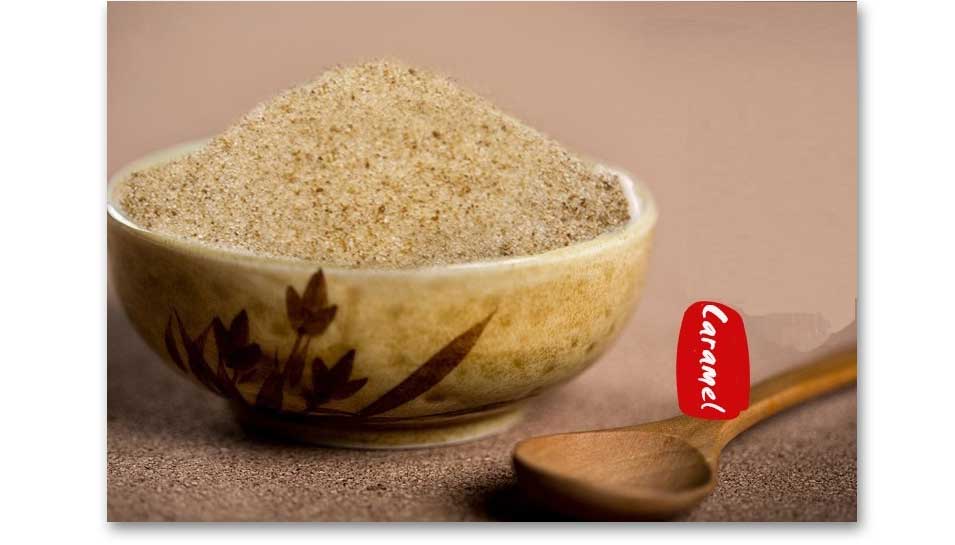
Selecting suitable caramel coating ingredients helps maintain consistent processing results.
For businesses that prefer a more convenient coating solution, XFD offers caramel powder for popcorn coating sugar. This ready-to-use caramel-flavored coating ingredient is designed for popcorn shops and factories. Its product information describes crystal particles that dissolve quickly and are intended to help prevent scorching.
Using a prepared coating ingredient can simplify ingredient handling, but manufacturers should still follow the supplier's recommended application method and test the finished product with their actual equipment.
Temperature control is another important part of preventing unwanted sugar crystallization. During caramel cooking, heat determines how quickly water evaporates, how concentrated the syrup becomes, and how the final coating behaves.
If the temperature is too low, the syrup may retain excessive moisture. The resulting coating can remain sticky and may not set properly after application. If the temperature is too high, the syrup can become overly concentrated, darken too quickly, or develop a burnt flavor.
Manufacturers should establish a suitable cooking temperature range based on their specific recipe and equipment. There is no single temperature that works for every caramel popcorn formulation because sugar concentration, water content, fat ingredients, and heating methods all influence the result.
Practical temperature management includes:
For industrial production, digital temperature controls can help operators maintain more repeatable processing conditions. XFD's industrial hot-air popcorn and caramelizer production line includes adjustable digital temperature settings and product-temperature monitoring. These functions can support more consistent operation when the equipment is properly configured for the selected recipe.
Mixing plays an important role in caramel popcorn production, but more agitation does not always mean better results. The timing and intensity of mixing should match the stage of the caramel preparation process.
During the initial preparation stage, mixing helps dissolve and distribute ingredients evenly. However, once the sugar syrup has reached the required concentration, unnecessary agitation during cooling may encourage crystal formation, especially when crystal nuclei are already present.
A practical approach is to separate the caramel preparation stage from the popcorn coating stage:
The coating stage has different requirements from sugar cooking. Once the caramel is ready, the objective is to spread it evenly across the popcorn rather than repeatedly stirring the sugar syrup itself.
XFD provides popcorn coating and caramelizing machines for different production applications. When selecting equipment, manufacturers should confirm whether the machine is designed for heated caramel cooking, ingredient mixing, or dry seasoning application. These functions are not interchangeable.
Even when the recipe and cooking temperature are correct, sugar crystals can still form if the equipment contains dried syrup or leftover sugar particles.
These small particles can act as crystal seeds. Once they enter a concentrated sugar mixture, additional sucrose molecules may attach to them and promote further crystal growth.
To reduce this risk, manufacturers should establish a regular cleaning and inspection routine:
For factories producing multiple caramel or flavored popcorn products, good cleaning practices are particularly important during product changeovers. They help reduce cross-contamination, improve process stability, and make quality control easier.
The process does not end when caramel has been applied to the popcorn. Cooling conditions also influence the final coating texture, product crispness, and storage stability.
If coated popcorn is cooled too slowly or exposed to humid air for too long, the coating may absorb moisture and become sticky. Changes in moisture content can also affect the physical stability of the sugar coating during storage.
Manufacturers should pay attention to the following factors:
In an industrial factory, cooling capacity should be matched to the output of the caramelizing equipment. If coated popcorn accumulates before cooling, product temperature and handling conditions may become inconsistent.
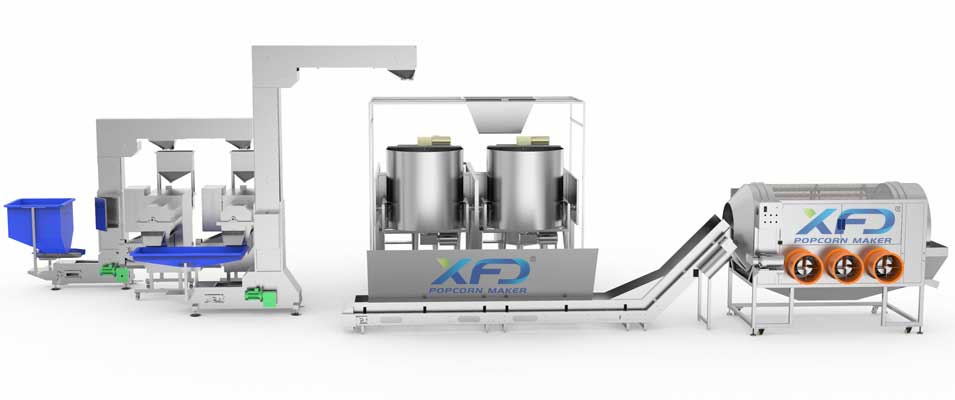
An integrated production layout helps coordinate popping, coating, and downstream processing.
For larger factories, an integrated large-scale popcorn production and coating line can help coordinate production stages. The line configuration should be evaluated according to the caramel recipe, required output, cooling needs, and packaging process.
When caramel popcorn develops a grainy or uneven coating, manufacturers should identify the source of the problem before changing the recipe. Adding more sugar or increasing the heating temperature without checking the actual cause may make the problem worse.
The following table provides a practical troubleshooting reference for commercial caramel popcorn production.
| Production Problem | Possible Cause | Recommended Action |
|---|---|---|
| Grainy caramel coating | Uncontrolled sucrose crystallization or crystal contamination | Review the sugar formulation, clean equipment, and control agitation. |
| Sticky caramel popcorn | Excess moisture, insufficient cooking, or poor cooling | Check cooking endpoint, cooling airflow, and packaging protection. |
| Uneven caramel coverage | Incorrect syrup viscosity or unsuitable mixing conditions | Adjust coating temperature, mixing speed, and feeding consistency. |
| Dark or burnt coating | Excessive heating or localized overheating | Check temperature sensors and maintain stable heating. |
| Different results between batches | Inconsistent ingredient ratios, cooking time, or operating conditions | Standardize recipes and record key production parameters. |
A useful quality-control practice is to record ingredient weights, cooking temperature, cooking time, mixing conditions, cooling time, and finished-product appearance for every test batch. This makes it easier to identify which variable is responsible when the coating quality changes.
Manual caramel preparation may be sufficient for small popcorn shops, but larger production facilities often need more stable heating, mixing, and material transfer. As production volume increases, small variations in each batch can become more noticeable and lead to greater product waste.
When evaluating industrial caramel popcorn equipment, manufacturers should consider the following:
XFD provides popcorn equipment solutions ranging from individual caramelizers to integrated industrial production lines. For example, its industrial hot-air popcorn and caramelizer line combines popcorn popping, pre-melting, caramelizing, conveying, and cooling equipment. The listed configuration is designed for caramel or chocolate popcorn production, with a stated output range of approximately 180–250 kg/h for that particular line.
The actual production output and coating quality depend on the selected configuration, recipe, operating conditions, and product requirements. Equipment selection should therefore be based on a complete production trial rather than rated capacity alone.
What is the best way to prevent sugar crystallization in caramel popcorn?
The most effective approach is to use a balanced sugar formulation, control cooking temperature and water evaporation, avoid unnecessary agitation during cooling, keep equipment clean, and manage the cooling process. Glucose syrup or invert sugar may also help reduce unwanted sucrose crystallization when used in a suitable formulation.
Why does caramel popcorn coating become grainy?
A grainy coating usually indicates unwanted sugar crystallization. Common contributing factors include excessive sugar concentration, crystal contamination, unsuitable agitation, and an unbalanced sugar formulation. Checking these conditions can help identify the source of the problem.
Does glucose syrup prevent sugar crystallization?
Glucose syrup can reduce sucrose crystallization by interfering with the formation and growth of sucrose crystals. However, the correct amount depends on the recipe and desired coating texture. Excessive use may make caramel softer or stickier.
What cooking temperature is suitable for caramel popcorn?
There is no universal cooking temperature for every caramel popcorn recipe. The suitable temperature depends on the sugar concentration, moisture level, ingredients, and equipment. Manufacturers should establish the correct cooking endpoint through recipe-specific testing and monitor actual product temperature.
Can excessive stirring cause sugar crystallization?
Yes. Excessive or poorly timed agitation can introduce crystal nuclei and encourage crystallization in concentrated sugar syrup. Mixing should follow the requirements of each processing stage rather than continuing throughout cooking and cooling.
How can manufacturers keep caramel popcorn crisp after coating?
Manufacturers should control caramel moisture, allow sufficient cooling, reduce exposure to humid air, and use packaging with suitable moisture-barrier properties. The finished product should also be checked after storage to confirm its texture remains stable.
What equipment is suitable for industrial caramel popcorn production?
Industrial production may require popcorn popping machines, caramelizers, mixing and coating systems, conveyors, cooling equipment, and packaging machines. The best configuration depends on the target output, recipe, and factory layout.
Can ready-made caramel coating sugar simplify production?
Yes. Ready-made caramel coating sugar can reduce ingredient preparation steps and simplify recipe handling. Manufacturers should check the product specifications, recommended usage, and compatibility with their popcorn equipment before using it in regular production.
Controlling sugar crystallization is not just about choosing the right sugar. It requires a consistent formulation, stable heating, appropriate mixing, clean equipment, and controlled cooling. When these factors are managed together, manufacturers can reduce grainy coatings, improve caramel distribution, and achieve more repeatable production results.
For popcorn shops and snack food factories looking to improve their production process, XFD offers caramel coating ingredients, caramelizing equipment, and industrial popcorn production solutions. Choosing equipment according to the actual recipe and production requirements can help build a more stable and efficient caramel popcorn manufacturing process.
Visit XFD Popcorn to explore popcorn equipment and production solutions for commercial and industrial applications.
 No.58 TongMing Road,TongAn District,XiaMen City,FuJian Province
 +86-592-5701935
If you are interested in any XFD product, please leave us a message, we will reply to you soon.
Copyright © 2012-2026 XFD XIAMEN MACHINERY TECHNOLOGY LTD..All Rights Reserved.
 English
 Deutsch
 русский
 español
 português
 Nederlands
 العربية
 हिंदी