Categories
New Blog
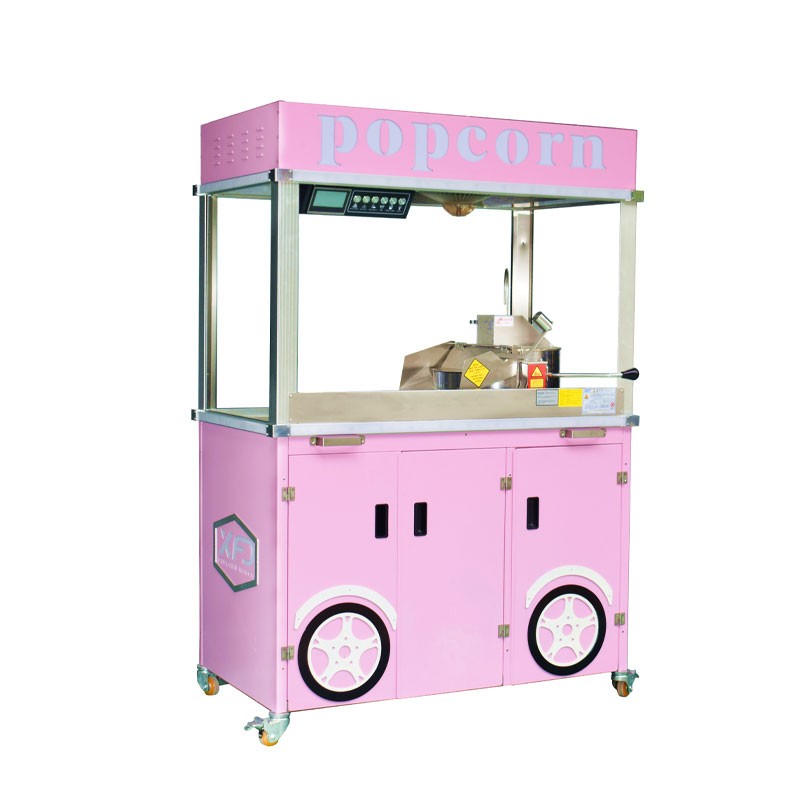
Choosing a popcorn machine for a high-traffic venue is different from choosing one for a small snack shop. In a busy cinema, stadium, amusement venue, or large concession stand, popcorn demand can increase sharply within a short period. The machine therefore needs to keep up with peak demand, not just average daily sales.
The right choice depends on several factors, including kettle capacity, production cycle, heating technology, number of kettles, labor requirements, available space, and how much finished popcorn needs to be ready for customers.
For many busy venues, a larger commercial or cinema popcorn machine is a practical starting point. When production requirements become significantly higher, twin-kettle, electromagnetic, automated, or industrial popcorn equipment may be more appropriate.
XFD provides popcorn equipment for different operating levels, including cinema popcorn machines, commercial popcorn machines, staging equipment, and industrial popcorn production lines.
For most high-traffic venues, the best popcorn machine is one that can produce enough popcorn during the busiest selling period without creating unnecessary equipment cost, labor requirements, or space problems.
In other words, the biggest machine is not automatically the best machine.
A busy cinema may need a 36 oz, 48 oz, or 52 oz machine, while another venue with similar customer traffic may benefit more from a twin-kettle configuration. A large popcorn manufacturer, on the other hand, may need an industrial production line rather than a larger concession machine.
The key question is: How much popcorn must the venue produce during its busiest 30 to 60 minutes?
Once peak demand is known, it becomes much easier to determine the appropriate kettle size, production configuration, and level of automation.
One of the most common mistakes when selecting commercial popcorn equipment is using average daily sales as the main calculation.
High-traffic venues rarely have evenly distributed popcorn sales. A cinema may sell relatively little popcorn between screenings but experience a major rush immediately before a movie starts. A stadium may see a similar increase before an event or during a break.
For this reason, buyers should estimate their busiest selling period rather than simply asking how much popcorn they sell in one day.
Consider these questions:
These answers provide a much better basis for equipment selection than simply choosing a machine based on its appearance or kettle size.
Kettle capacity is one of the most important specifications when comparing popcorn machines for a high-traffic venue.
XFD offers popcorn machines in different capacities, including 28 oz, 32 oz, 36 oz, 48 oz, and 52 oz configurations, as well as twin-kettle equipment.
For a smaller commercial location, a smaller kettle may provide enough production without occupying unnecessary space. For cinemas, stadium concession stands, and other high-volume locations, larger kettle capacities can reduce the number of batches required during peak periods.
| Venue Situation | Equipment Direction | Main Consideration |
|---|---|---|
| Moderate commercial traffic | Smaller commercial machine | Space and moderate production demand |
| Busy concession stand | 28–36 oz or larger | Frequent batches during peak periods |
| High-traffic cinema | 36–52 oz or twin kettle | Fast batch turnover and higher output |
| Factory-scale production | Industrial popcorn production line | Continuous or large-scale production |
These ranges should be treated as a starting point rather than a universal rule. Actual equipment selection should be based on the venue's expected peak production requirement.
A twin-kettle machine can be useful when a venue needs a higher production rate but still wants to operate within a concession-style equipment format.
Instead of relying on one kettle for every batch, two kettles can provide greater production flexibility. Depending on the equipment design, one kettle can be producing while the other is being prepared or discharged.
This is particularly useful when customer traffic comes in waves. Cinemas, stadiums, entertainment centers, and large concession stands often experience this type of demand pattern.
XFD's 32 oz–52 oz Enclosed President 6' Cabinet combines electric and electromagnetic heating technologies and uses two independently controlled kettles. XFD states that the two kettles can produce almost 100 lb of popcorn per hour under its listed operating conditions.
For a high-traffic venue where production continuity is important, comparing twin-kettle equipment with a single larger kettle can therefore be worthwhile.
Heating technology becomes increasingly important when a popcorn machine is expected to operate frequently throughout the day.
Electromagnetic heating can provide fast heating and efficient batch production, making it particularly relevant to commercial locations that need frequent popcorn production.
XFD's 52 oz electromagnetic popcorn machine is designed for large venues, cinemas, stadiums, and similar commercial applications. The machine has a 52 oz capacity, 12 kW power rating, and a stated three-minute kettle production cycle.
It also includes features such as automatic oil feeding, automatic cooling, exhaust, oil melting, and PLC control.
For venues where the machine needs to produce batch after batch during concentrated rush periods, an XFD 52 oz electromagnetic popcorn machine can be one configuration worth evaluating.
Not every high-traffic venue has the same popcorn production pattern. The type of venue should therefore be part of the equipment selection process.
Cinemas usually have highly concentrated popcorn demand. Customers may purchase popcorn immediately before a screening or during a short intermission.
For this type of operation, fast batch production, sufficient kettle capacity, reliable operation, and adequate holding space are especially important.
For larger cinemas, buyers can compare larger kettle configurations, twin-kettle systems, and electromagnetic popcorn machines according to the number of customers served during peak periods.
Stadiums and entertainment venues can experience even more unpredictable traffic. Large groups of customers may arrive at concession stands within a very short period.
In this environment, production speed matters because the machine may need to recover quickly after each batch. The amount of finished popcorn that can be kept ready for service is also important.
A snack shop may have high customer traffic but a different product mix. The business may need traditional popcorn as well as caramel, chocolate, cheese, or other flavored popcorn.
In this situation, production flexibility may be more important than simply choosing the largest kettle.
XFD's commercial popcorn machine range can be considered when the application requires a balance between production capacity, flexibility, and available space.
A popcorn machine should also be evaluated based on how much attention it requires from staff.
During a rush, employees are usually busy serving customers, preparing orders, handling payments, and maintaining the concession area. If the popcorn machine requires constant manual intervention, it can become a bottleneck.
Depending on the model, XFD popcorn machines can include automatic oil feeding, automatic cooling, oil melting, exhaust systems, automatic kettle cleaning, PLC control, and other labor-saving functions.
The purpose of automation is not simply to add more features. The more useful question is:
Which manual steps are slowing down production when customer traffic is at its highest?
If oil preparation, kettle operation, cooling, or cleaning is creating a recurring bottleneck, an automated feature may provide a practical benefit.
High-volume popcorn production does not end when the popcorn leaves the kettle.
The finished popcorn also needs to remain available, fresh, and easy to serve. If a venue produces popcorn quickly but has nowhere suitable to hold it, the production capacity of the machine may not translate into better customer service.
This is why the holding and serving system should be considered together with the popcorn machine.
XFD provides popcorn staging cabinets designed for concession operations. These systems can help keep finished popcorn ready for service while supporting a more organized serving area.
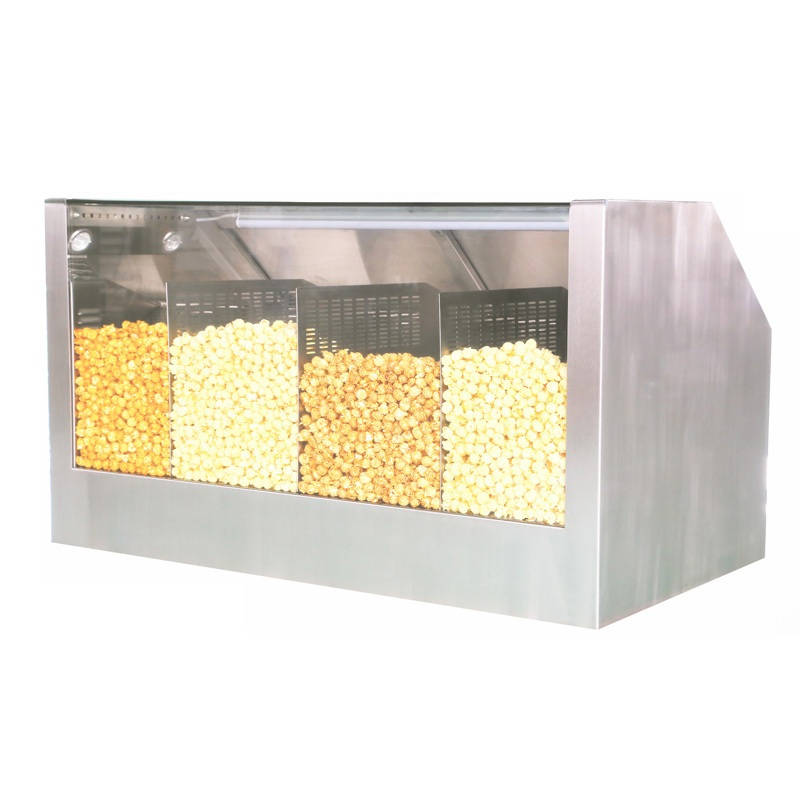
For a busy venue, the complete setup should therefore be considered as a system: popcorn production + holding + serving.
High customer traffic does not automatically mean that a venue needs an industrial popcorn production line.
Commercial and cinema popcorn machines are generally more appropriate when popcorn is produced directly for customers at a concession location.
Industrial equipment becomes more relevant when popcorn is being produced at factory scale for wholesale distribution, packaged snack products, multiple retail locations, or continuous production.
XFD's industrial popcorn machine and production line solutions are designed for larger-scale popcorn manufacturing. The industrial range includes electromagnetic and hot-air production systems that can be configured for higher production requirements.
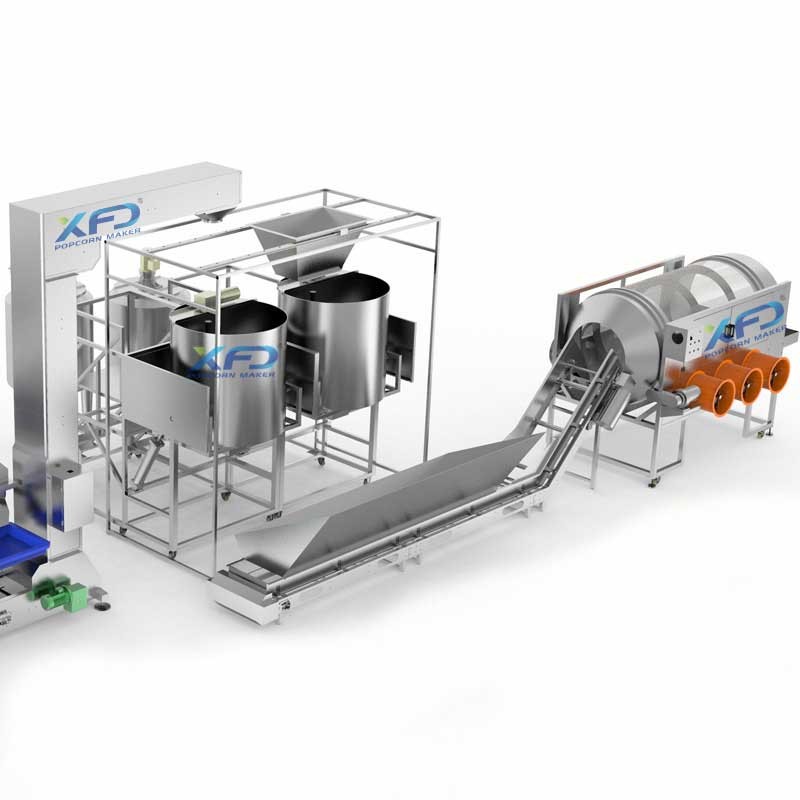
The important distinction is therefore not simply how many customers visit the venue. It is whether the business needs concession-scale production or factory-scale production.
A simple way to estimate the required capacity is to focus on the busiest selling period.
For example, if a venue expects 300 popcorn servings during a 30-minute rush, the equipment needs to support that demand through a combination of batch size, production cycle, and available finished popcorn.
The calculation should therefore consider more than kettle capacity:
This is why two machines with similar kettle sizes may perform differently in an actual high-traffic concession environment.
A single-kettle popcorn machine can be a good choice when production demand is moderate or when the business mainly needs larger batches at specific times.
A twin-kettle machine becomes more attractive when demand is high and production needs to continue with minimal interruption.
For example, a cinema that experiences a large customer rush immediately before screenings may benefit from having two kettles available rather than relying on one production cycle at a time.
The best choice therefore depends on how demand arrives, not just how much popcorn is sold each day.
Before contacting a popcorn equipment manufacturer, prepare the following information:
Providing this information gives the manufacturer a much clearer picture of the actual application and makes it easier to recommend a suitable configuration.
There is no single popcorn machine that is ideal for every high-traffic venue.
For cinemas and large concession operations, larger kettle machines, twin-kettle systems, and electromagnetic popcorn machines are worth comparing. For general commercial applications, a commercial popcorn machine may provide the right balance between capacity and flexibility. For factory-scale production, an industrial popcorn production line is more appropriate.
XFD's equipment range covers these different application levels, allowing the machine to be selected according to the actual production requirement instead of simply choosing the largest available model.
The most useful information for an equipment recommendation is therefore not only the number of seats or customers. The manufacturer should understand peak demand, production frequency, batch requirements, available space, power supply, labor availability, and the way finished popcorn is served.
For many high-traffic venues, 36 oz, 48 oz, 52 oz, or twin-kettle popcorn machines are useful configurations to consider. The correct size depends on peak demand, production cycle, and serving requirements rather than venue size alone.
Yes. A 52 oz popcorn machine can be suitable for a busy cinema when the venue needs larger batches and fast production during concentrated rush periods. XFD's 52 oz electromagnetic model is designed for cinemas, stadiums, and other large venues and has a stated three-minute kettle production cycle.
Not necessarily. A twin-kettle machine is useful when production continuity and high output are important. A single larger kettle may be more appropriate when the business mainly needs larger individual batches. The choice should follow the venue's customer flow.
Yes. Electromagnetic popcorn machines can be considered for cinemas, stadiums, concession areas, and other commercial locations where fast and repeatable production is important. XFD provides electromagnetic popcorn machines in different kettle capacities and configurations.
Not necessarily. A high-traffic cinema or concession stand can normally use commercial or cinema popcorn equipment. Industrial popcorn equipment is more appropriate when the business needs factory-scale production for wholesale, packaging, multiple locations, or continuous manufacturing.
Provide the venue type, peak customer traffic, estimated popcorn demand, expected production during the busiest period, available installation space, voltage, popcorn type, and whether you need single-kettle, twin-kettle, electromagnetic, or automated equipment. These details help the manufacturer recommend a more suitable configuration.
Choosing a popcorn machine for a high-traffic venue starts with peak demand rather than average demand.
The right equipment should produce enough popcorn during busy periods while fitting the venue's space, labor model, power supply, production process, and serving requirements.
For cinemas and large concession operations, larger kettle capacities, twin-kettle systems, and electromagnetic heating are worth considering. For businesses producing popcorn at factory scale, an automated industrial production line may be a better solution.
By evaluating the entire process—from popping and batch production to holding and serving—business owners can select a popcorn machine that supports both customer service and long-term operating efficiency.
 No.58 TongMing Road,TongAn District,XiaMen City,FuJian Province
 +86-592-5701935
If you are interested in any XFD product, please leave us a message, we will reply to you soon.
Copyright © 2012-2026 XFD XIAMEN MACHINERY TECHNOLOGY LTD..All Rights Reserved.
 English
 Deutsch
 русский
 español
 português
 Nederlands
 العربية
 हिंदी
हिंदी