Categories
New Blog
Production bottlenecks in an automated popcorn manufacturing line occur when one processing stage cannot keep up with the output of another. Popping may run efficiently, for example, but conveying, cooling, coating, or packaging may not have enough capacity to handle the same volume. The result is product accumulation, equipment waiting time, and lower output from the complete line.
The key to resolving a bottleneck is to identify where product flow is being restricted rather than assuming the popping machine is always responsible. A well-balanced popcorn production line needs compatible equipment capacities, stable ingredient feeding, efficient transfer, appropriate cooling and coating, and packaging equipment that can handle the actual output.
XFD provides industrial popcorn equipment and integrated production-line configurations for different factory requirements. By examining the output and operating conditions of each stage, manufacturers can identify the real production constraint and decide whether process adjustments or equipment upgrades are needed.
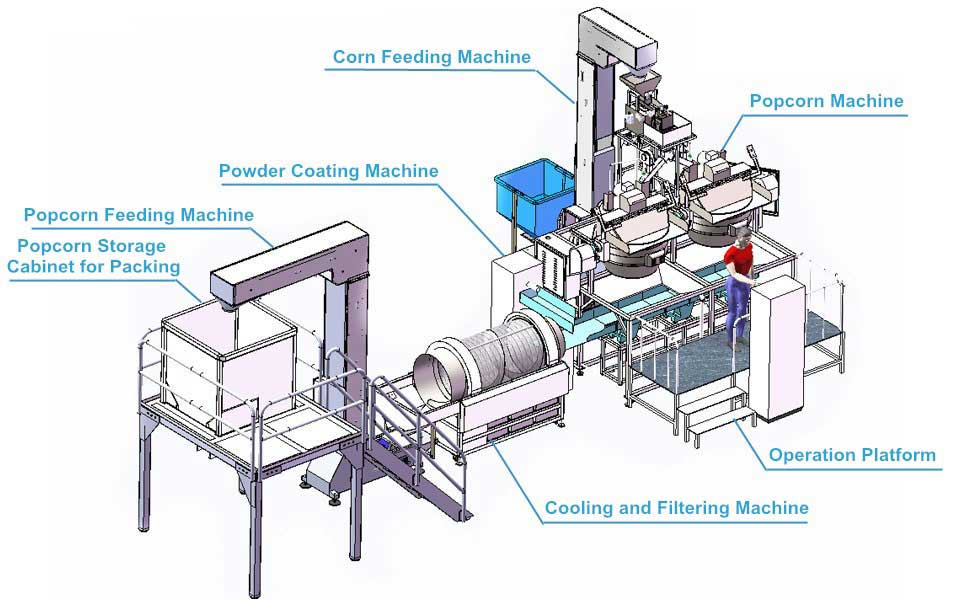
The most common bottleneck locations are popping, ingredient feeding, conveying, cooling and filtering, coating, and packaging. The exact constraint depends on the popcorn recipe, equipment configuration, production schedule, and target output.
| Production stage | Possible bottleneck | What to check |
|---|---|---|
| Popping | The popping stage cannot supply enough finished popcorn | Batch cycle time, number of kettles, loading and unloading time |
| Ingredient feeding | Kernels, oil, sugar, or seasoning are not supplied consistently | Feeding intervals, replenishment delays, ingredient availability |
| Conveying | Product accumulates between processing stages | Transfer speed, conveyor capacity, discharge points and layout |
| Cooling and filtering | Product waits for cooling or separation before the next operation | Throughput, airflow, separation performance, cleaning intervals |
| Coating and seasoning | The coating process cannot handle the incoming product flow | Recipe, mixing time, coating method, changeover and cleaning time |
| Packaging | Finished popcorn accumulates before filling or sealing | Filling rate, bag format, sealing speed, film replenishment and rejected packs |
These are common diagnostic possibilities, not proof that a particular machine is underperforming. Manufacturers should compare actual throughput and downtime at each stage before deciding which equipment needs adjustment or replacement.
The popping stage may be the main constraint when downstream equipment is waiting for popcorn instead of receiving it at a steady rate. This can happen when the number of popping kettles is insufficient, batch cycles take longer than expected, or loading, unloading, and ingredient replenishment create excessive gaps between batches.
To diagnose the problem, record the number of batches completed per hour, the average cycle time, the weight of acceptable popcorn produced per batch, and the time spent waiting between cycles. Rated capacity is useful as a reference, but actual output is a more reliable indicator of what the factory can sustain during normal operation.
XFD's industrial popcorn machines cover different production requirements. When evaluating a popping-stage upgrade, manufacturers should compare the selected machine's output, batch cycle, staffing requirements, and compatibility with downstream equipment rather than relying on rated capacity alone.
If popping is confirmed as the constraint, possible actions include reviewing batch timing, reducing avoidable waiting, improving ingredient supply, or evaluating additional popping capacity. Increasing popping capacity alone will not improve total line output if cooling, coating, or packaging is already operating at its limit.
Conveying equipment connects individual machines into a working production process. Even when each machine has sufficient nominal capacity, a poorly matched conveyor or elevator can interrupt the flow of popcorn between stages.
A common warning sign is product accumulating at a discharge point while the next machine waits for material. The opposite can also occur: downstream equipment remains underused because the upstream machine does not deliver popcorn consistently.
Check whether the conveyor's capacity, height, transfer direction, and discharge arrangement match the production line. Product handling should also minimize unnecessary drops, excessive movement, and accumulation that could increase breakage or make cleaning more difficult.
When a factory expands production by adding popping machines, it should reassess the capacity of the shared conveying system. More popping capacity can increase the volume entering the transfer stage, so the conveyor and downstream equipment may need to be reviewed as part of the same upgrade.
A production line should be evaluated as a connected system, not simply as a collection of machines with individual capacity figures.
After popping, popcorn may need cooling and separation before coating or packaging. If this stage cannot accept the incoming product flow, popcorn can accumulate upstream and force the popping process to slow down.
Cooling performance depends on the product, process conditions, equipment configuration, and required output. Filtering and separation requirements also matter because unpopped kernels, small fragments, and other unwanted material may need to be removed before the product moves forward.
Manufacturers should check the quantity of popcorn entering and leaving the cooling stage over the same time period. They should also observe whether product waits for cooling, whether separation results remain consistent, and whether cleaning or maintenance interrupts normal operation.
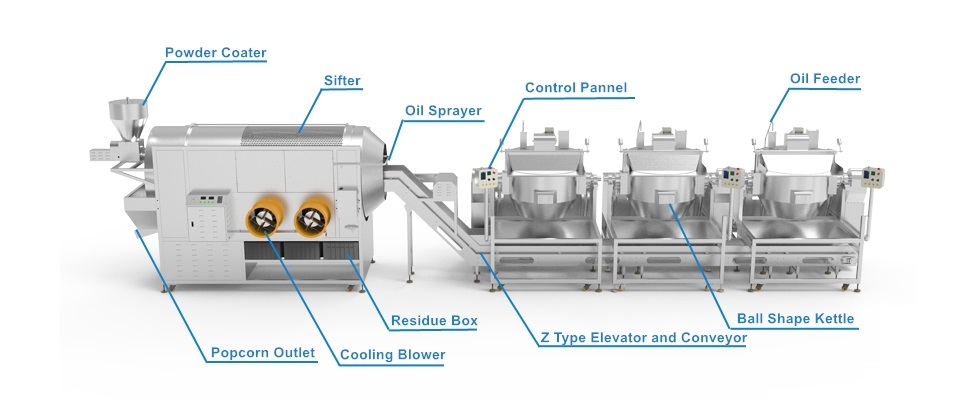
The image illustrates how cooling, conveying, sifting, and popping equipment work together. If the cooling or filtering stage cannot handle the upstream output, the entire line may need to slow down even when the popping equipment itself is operating normally.
For factories evaluating a production line that includes cooling and product transfer, XFD's semi-automatic popcorn production and cooling line is one configuration to review. The product page describes a modular setup that can be expanded with additional popping machines according to production needs.
Coating can become the limiting stage when the recipe requires more processing time than the popping equipment allows for, or when the coating method does not match the product. Caramel popcorn, for example, may require a different heating and mixing process from popcorn coated with dry seasoning powder.
Other possible causes include inconsistent ingredient feeding, uneven coating distribution, excessive product accumulation, and cleaning or changeover time between flavors. A factory making several varieties should measure not only the time spent processing each batch but also the time required to switch recipes and clean the equipment.
The correct solution depends on the coating process. A dry seasoning system is not automatically suitable for cooking a sticky caramel coating, and a machine designed for one recipe may not deliver the same throughput with another. The ingredients, mixing action, heating requirements, cleaning method, and target output should all be considered.
XFD's popcorn production and coating line combines popping, conveying, cooling and filtering, and powder-coating equipment in one configuration. Manufacturers can use the listed components as a starting point when assessing where coating or product transfer may restrict output.
Packaging is a frequent source of production delays because the finished product cannot be shipped until it has been filled, sealed, and prepared according to the required format. If the packaging machine processes fewer kilograms per hour than the upstream line produces, popcorn may accumulate before packing.
Packaging speed should be evaluated in the context of bag size and filling weight. A machine's packs-per-minute figure cannot be compared directly with another machine's kilograms-per-hour figure unless the package weight and operating assumptions are known.
Manufacturers should check the actual number of acceptable packs produced per minute, filling accuracy, sealing quality, film replenishment time, and the number of rejected packages. Product accumulation can also reveal whether the packaging system is intermittently stopping while the rest of the line continues to operate.
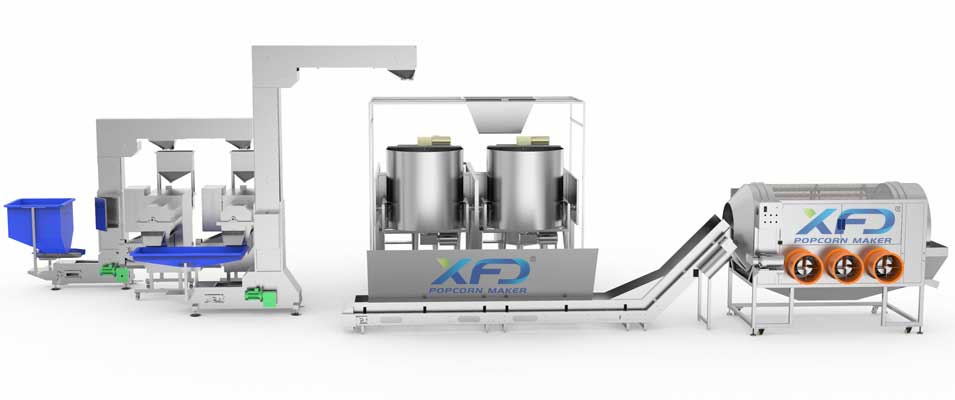
For factories that need to coordinate production and packing, XFD's fully automatic popcorn production and packing line is designed for factory applications. Its product page lists an output range of approximately 100–160 kg/h for the specified configuration. Actual throughput will depend on the product, operating conditions, and selected setup.
Before increasing upstream capacity, confirm that the packaging system can handle the expected finished output. Otherwise, the factory may invest in additional popping capacity without achieving a corresponding increase in packaged product.
The most effective method is to measure the performance of each stage over the same operating period. Looking at only one machine's rated capacity can be misleading because actual line output is affected by waiting time, changeovers, cleaning, material supply, and rejected product.
Start with a production record that includes the following indicators:
A simple example illustrates the principle. If the popping stage produces 100 kg/h, the cooling stage can process 90 kg/h, and packaging handles 75 kg/h under the same product and operating assumptions, packaging may limit the final output to around 75 kg/h before additional downtime and losses are considered.
These figures are illustrative, not XFD product specifications. In a real factory, measurements should be taken over comparable periods, and product weight, recipe, and output definitions should be consistent across the stages.
The slowest stage is not always the only problem. A line may have intermittent bottlenecks caused by changeovers, uneven feeding, or equipment stops. Reviewing the entire process over a complete production shift helps distinguish a persistent capacity constraint from a temporary interruption.
Reducing bottlenecks does not always require replacing the entire line. The appropriate response depends on whether the constraint comes from insufficient capacity, unstable operation, poor equipment coordination, or avoidable downtime.
Automation can help coordinate repetitive operations and reduce some manual handling, but it does not remove every production constraint. A fully automatic line still needs the correct equipment balance, suitable ingredients, routine cleaning, maintenance, and quality checks.
When planning a new installation, manufacturers should provide the supplier with the target output in kg/h, product varieties, coating recipes, packaging format, available floor space, power supply, and expected operating schedule. This information makes it easier to assess the whole production process instead of selecting equipment based on a single capacity figure.
The goal is not simply to purchase the fastest popping machine. It is to build a production process in which popping, transfer, cooling, coating, and packing can work together at a practical and sustainable rate.
When reviewing a proposed line, manufacturers should confirm the expected output of the complete configuration using their intended popcorn type and coating process. They should also check which equipment is included, how product moves between stages, what packaging format is supported, and which operating assumptions apply to the stated capacity.
For an existing factory, share actual production records and explain where product accumulates or machines remain idle. For a new factory, provide the planned output, product range, available utilities, and future expansion requirements. This allows the equipment configuration to be evaluated against the real production target.
Where do production bottlenecks usually occur in an automated popcorn manufacturing line?
They commonly occur at popping, ingredient feeding, conveying, cooling and filtering, coating, or packaging. The actual bottleneck is the stage that limits the flow of acceptable finished product under the factory's operating conditions.
How can a factory identify the bottleneck in a popcorn production line?
Measure actual throughput at each stage over the same period, record downtime and waiting time, and observe where popcorn accumulates. Compare the data using consistent product and output definitions before deciding which stage needs improvement.
Can a higher-capacity popcorn machine solve all production bottlenecks?
No. Increasing popping capacity may not improve total output if conveying, cooling, coating, or packaging cannot handle the additional product. The full line should be evaluated before increasing the capacity of one stage.
Why does popcorn accumulate before the packaging machine?
Accumulation can occur when the packaging stage processes product more slowly than the upstream line supplies it. Filling speed, bag format, sealing performance, film replenishment, rejected packs, and machine downtime should be checked.
How does cooling equipment affect industrial popcorn production capacity?
If cooling and filtering cannot accept the incoming product flow, popcorn may wait between stages and force upstream equipment to slow down. The cooling system should be evaluated against the product, process requirements, and actual line throughput.
What information should a manufacturer provide when choosing an automated popcorn production line?
Provide the target output in kg/h, popcorn varieties, coating recipes, packaging format, factory layout, available power supply, operating schedule, and any existing production data. These details help the supplier evaluate a configuration for the complete process.
 No.58 TongMing Road,TongAn District,XiaMen City,FuJian Province
 +86-592-5701935
If you are interested in any XFD product, please leave us a message, we will reply to you soon.
Copyright © 2012-2026 XFD XIAMEN MACHINERY TECHNOLOGY LTD..All Rights Reserved.
 English
 Deutsch
 русский
 español
 português
 Nederlands
 العربية
 हिंदी