Categories
New Blog
How much does it really cost to produce one kilogram of popcorn in a factory? The answer depends on more than the price of corn kernels. Manufacturers also need to account for popping oil, sugar or seasoning, labor, electricity, packaging, equipment depreciation, cleaning, and production losses. The most reliable way to calculate the cost is to divide the total production expenses for a defined period by the kilograms of finished popcorn produced during that same period.
For snack manufacturers, this calculation helps compare production methods, evaluate equipment investments, set wholesale prices, and identify where avoidable expenses occur. XFD provides industrial popcorn production equipment for different factory requirements, including popping, coating, and related processing operations. Understanding the cost structure first makes it easier to determine which equipment configuration fits a business's actual production needs.
The basic formula is straightforward:
Production cost per kilogram = Total production costs ÷ Total kilograms of finished popcorn produced
For this calculation to be meaningful, both figures must cover the same production period and the same cost scope. For example, a factory calculating its manufacturing cost for one month should include the production expenses incurred during that month and divide them by the kilograms of finished popcorn produced during the same period.
Manufacturers should also define what counts as finished product. Plain popped popcorn, caramel-coated popcorn, and packaged retail popcorn can have different cost structures. If the objective is to calculate the cost of a finished, packaged product, coating ingredients and packaging materials should be included rather than treating the popped kernels as the final output.
It is useful to distinguish manufacturing cost from the full cost of selling a product. Freight to customers, sales commissions, marketing, and other distribution expenses may need to be added when calculating the total delivered cost or evaluating profitability. These expenses should not be mixed into a manufacturing-cost figure without clearly identifying the scope.
A practical cost calculation separates expenses into categories. This makes it easier to identify the largest cost drivers and compare one production setup with another.
Raw materials. Corn kernels, popping oil, sugar, caramel ingredients, salt, and seasoning powders all contribute to the cost of the finished product. The amount used per kilogram can vary with the recipe, coating level, popping yield, and material losses. For flavored popcorn, calculate the cost of each ingredient based on the quantity actually consumed by the batch.
Direct labor. Include the labor required for material preparation, machine operation, product transfer, quality checks, cleaning, and packing. Even where a line is automated, manufacturers should account for the operators and support staff needed to run it.
Energy and utilities. Electricity or other energy used for popping, coating, conveying, cooling, and packaging contributes to production cost. The calculation should use the actual energy consumed during the production period whenever possible, rather than relying only on a machine's rated power.
Packaging materials. Bags, cups, cartons, labels, and other packaging components matter when calculating the cost of a retail-ready product. The packaging cost per kilogram depends on the pack size, material specification, number of bags used, and rejected or damaged packs.
Equipment and maintenance. Include equipment depreciation or another consistently applied equipment-cost allocation, along with routine maintenance, replacement parts, and other production-related expenses. Equipment purchase price alone does not show the full cost of operating a line over its useful life.
Waste and quality losses. Unpopped kernels, broken pieces, coating defects, spills, rejected packages, and product that cannot be sold all affect the cost of saleable output. A factory may spend the same amount on materials but report a higher cost per kilogram if a smaller share of production becomes saleable finished product.
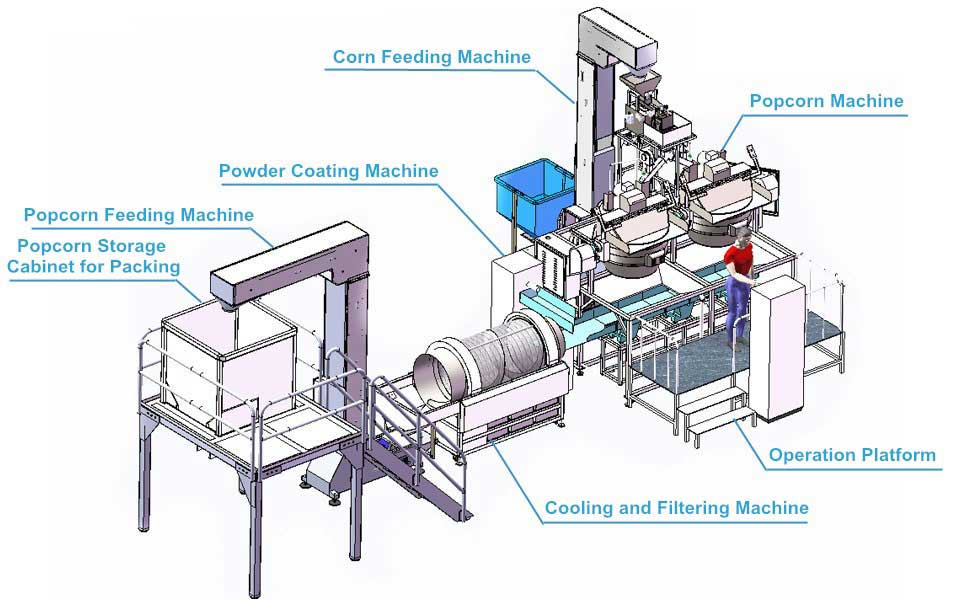
For factories producing flavored popcorn at scale, the cost of coating should be assessed separately from popping. XFD's popcorn production and coating line combines multiple processing stages, making it relevant when evaluating the equipment and operating costs associated with both popping and flavor application.
Ingredient cost should be calculated from actual consumption and the quantity of finished popcorn produced. A simple way to start is to calculate the cost of each ingredient used in a batch, add the ingredient costs together, and divide that total by the batch's saleable output in kilograms.
Ingredient cost per kilogram = Total ingredient cost for the batch ÷ Saleable finished kilograms from the batch
Consider a hypothetical batch that uses corn kernels costing $120, oil costing $25, and flavoring ingredients costing $35. The total ingredient cost is $180. If the batch produces 90 kg of saleable finished popcorn, the ingredient cost is $2.00 per kilogram.
This is an illustrative calculation, not an XFD customer cost benchmark or a market price. Actual costs will depend on local supplier quotations, the recipe, ingredient prices, production yield, and the amount of finished product that meets quality requirements.
For caramel or heavily seasoned popcorn, ingredient usage should be tracked carefully. A change in coating ratio may increase the finished product's weight while also increasing material consumption. Comparing batches only by the cost of corn kernels can therefore give an incomplete picture of the final cost.
Production capacity affects unit cost because some operating expenses are spread across the finished output. If a factory produces more saleable popcorn during the same operating period without a proportional increase in fixed costs, the fixed-cost portion per kilogram may decrease.
However, rated machine capacity is not the same as actual daily output. Actual production depends on operating hours, batch cycle time, material supply, cleaning, changeovers, downtime, coating requirements, and packaging performance. A machine with a higher rated output will not automatically produce a lower-cost kilogram if it runs inefficiently or creates more product losses.
For example, XFD lists an industrial electromagnetic popcorn production line with an output of approximately 80 kg/h, while a multiple-machine configuration is listed at approximately 160 kg/h. These are model-specific published capacities, not guaranteed production results for every factory. The actual output and cost should be evaluated against the selected configuration and operating conditions.
When comparing equipment, manufacturers can review XFD's industrial electromagnetic popper production line with multiple popcorn machines to understand how a multi-machine arrangement may fit a higher-output production plan.
The useful comparison is not simply the cost of one machine against another. It is the total cost of producing a kilogram of acceptable finished popcorn at the output level the factory can realistically sustain.
Labor and energy should be allocated to the production process using a consistent method. If a factory produces several products on the same equipment, it can allocate shared costs according to machine operating hours, production time, energy consumption, or another reasonable measure that reflects how the resources are used.
For labor, record the hours spent on each production shift and identify which activities support the batch. For energy, use meter readings where available. If direct measurement is not possible, estimates can be based on measured operating time and equipment consumption, but the assumptions should be documented and reviewed.
Automation can reduce some repetitive handling and help coordinate production stages, but the actual savings depend on the production setup. A fully automatic line may require less manual intervention in certain stages, while still needing operators for supervision, replenishment, sanitation, maintenance, and quality control.
When evaluating a line, compare expected labor hours and energy use per kilogram alongside purchase price and output. XFD's fully automatic popcorn production and packing line is one option for factories assessing integrated production and packing equipment. Its published specifications can help start the equipment comparison, while a factory-specific quotation and production assessment are needed for a reliable cost estimate.
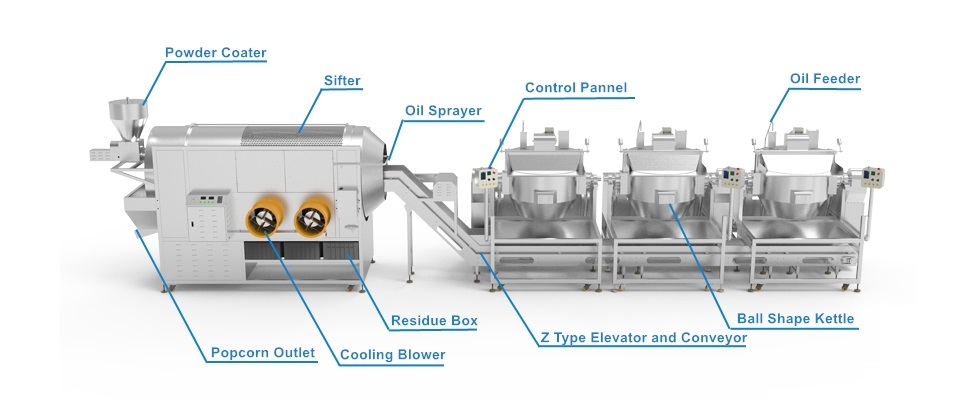
For finished flavored popcorn, popping is only one part of the production process. Coating, cooling, and packaging can add material, energy, labor, maintenance, and waste costs. These stages should be included whenever the cost target is a coated or packaged product rather than plain popped popcorn.
Coating costs depend on the type and quantity of sugar, caramel, oil, salt, or seasoning applied. If excess coating is discarded or the coating is uneven, the factory may consume more ingredients per kilogram of saleable product. Cooling and conveying should also be considered where they affect throughput, product handling, or breakage.
Packaging cost should be calculated using the actual number and type of packages consumed. For example, a product packed into small retail bags may require more packaging material per kilogram than a bulk product. Sealing defects, inaccurate filling, and damaged bags can further increase the cost of saleable output.
XFD also offers a hot-air industrial popcorn oven production line equipped for popcorn production and powder coating. When comparing different production methods, manufacturers should assess the full processing sequence, not just the popping stage, to understand the cost of the final product.
The most effective cost reductions usually come from identifying measurable losses rather than simply choosing the lowest-priced equipment. Manufacturers can begin by tracking a small set of operating indicators across multiple production runs.
Any proposed change should be tested against product quality, consistency, food safety, and customer requirements. Reducing ingredient use is not a saving if it results in an unacceptable flavor, poor coating, or more rejected product. Likewise, increasing line speed is not beneficial if downstream cooling or packaging cannot handle the additional output.
Factories can use the following worksheet to calculate a cost per kilogram using their own operating records. The figures should cover the same production period, and all costs should use the same currency.
| Cost category | What to record |
|---|---|
| Raw materials | Corn kernels, oil, sugar, salt, and flavoring ingredients used |
| Labor | Production and packing labor allocated to the period |
| Energy and utilities | Measured or consistently estimated production energy use |
| Packaging | Bags, cartons, labels, and other packaging materials |
| Equipment and maintenance | Depreciation allocation, servicing, and production-related parts |
| Other manufacturing costs | Cleaning supplies and other relevant production overhead |
| Total production cost | Sum of the applicable cost categories |
| Saleable output | Total kilograms of finished product that meet quality requirements |
| Cost per kilogram | Total production cost divided by saleable output |
For an apples-to-apples comparison, use the same product recipe, cost definitions, and accounting period. If two lines produce different popcorn varieties or packaging formats, calculate the cost for each product separately before comparing the results.
Choosing equipment for a popcorn factory starts with the target product, expected output, available space, production process, and level of automation. A small operation and a factory serving wholesale customers may need very different configurations.
XFD's industrial equipment range includes electromagnetic popcorn production lines, hot-air popcorn production and coating lines, and integrated production and packing solutions. These options give manufacturers different configurations to assess according to their output requirements and operating plans.
Before requesting a quotation, prepare the information that has the greatest influence on the cost calculation:
With these details, the equipment configuration can be evaluated against the factory's production goals. A useful quotation should make it possible to compare the equipment scope, capacity assumptions, installation requirements, and operating considerations rather than relying on purchase price alone.
For manufacturers planning a new line or upgrading an existing factory, XFD offers industrial popcorn production equipment for different output requirements. Contact XFD with your target capacity, popcorn type, coating requirements, and packaging needs to discuss a suitable production line configuration and evaluate the expected operating costs.
How do you calculate the cost of producing one kilogram of popcorn?
Calculate the total production expenses for a defined period and divide them by the kilograms of saleable finished popcorn produced during the same period. Include raw materials, labor, energy, packaging, equipment costs, maintenance, and relevant production overhead according to the cost scope being measured.
What is the biggest cost in popcorn manufacturing?
There is no single cost category that is largest for every factory. Ingredient prices, recipe, labor rates, energy use, packaging format, production scale, and product yield all influence the result. Manufacturers should use their own production records to identify the largest cost drivers.
Does a higher-capacity popcorn machine always lower the cost per kilogram?
No. Higher capacity can spread some fixed costs across more output, but the actual cost depends on utilization, energy consumption, staffing, maintenance, product yield, and downtime. Compare the cost per kilogram of saleable finished product under realistic operating conditions.
Should packaging be included in the cost per kilogram?
Yes, if the calculation is intended to represent the cost of finished packaged popcorn. If the calculation covers bulk popcorn before packaging, record that scope clearly and calculate packaging costs separately.
How do you calculate the cost of caramel popcorn per kilogram?
Include the cost of popped corn, oil, sugar or caramel ingredients, other recipe components, labor, energy, coating-related processing, packaging if applicable, and production losses. Divide the total cost by the saleable kilograms of finished caramel popcorn.
What information is needed to estimate the operating cost of an industrial popcorn production line?
Useful inputs include the target output, product recipe, operating hours, actual energy consumption, labor requirements, packaging format, maintenance assumptions, and expected saleable yield. Equipment specifications and a factory-specific quotation can help establish the basis for further evaluation.
 No.58 TongMing Road,TongAn District,XiaMen City,FuJian Province
 +86-592-5701935
If you are interested in any XFD product, please leave us a message, we will reply to you soon.
Copyright © 2012-2026 XFD XIAMEN MACHINERY TECHNOLOGY LTD..All Rights Reserved.
 English
 Deutsch
 русский
 español
 português
 Nederlands
 العربية
 हिंदी