 English
 Deutsch
 русский
 español
 português
 Nederlands
 العربية
 हिंदी
हिंदी



Building a commercial popcorn production workflow means connecting each processing stage into a consistent, efficient system. A typical workflow includes raw material preparation, popping, flavor coating, cooling, quality inspection, and packaging. The exact equipment depends on the required output, popcorn flavors, available factory space, and level of automation.
For popcorn manufacturers, the goal is not simply to produce more popcorn. The production line must also maintain a consistent texture, distribute seasonings evenly, reduce unnecessary handling, and deliver a finished product that is ready for storage or distribution. XFD provides commercial and industrial popcorn equipment that can be configured for different production requirements.
Before selecting individual machines, it is useful to map the complete process and identify how popcorn moves from one stage to the next.
What Is a Commercial Popcorn Production Workflow?
A commercial popcorn production workflow is the sequence of operations used to turn raw corn kernels into finished popcorn products at a business or factory scale. Depending on the recipe, it may involve oil popping or hot-air popping, caramel preparation, seasoning application, cooling, screening, and packaging.
A basic production sequence looks like this:
Raw material inspection
↓
Kernel feeding and popping
↓
Flavor preparation and coating
↓
Cooling and separation
↓
Quality inspection
↓
Packaging and finished-product storage
Not every factory needs a fully automated line. A small producer may operate separate machines with manual transfers, while a high-volume manufacturer may benefit from integrated feeding, conveying, coating, cooling, and packaging equipment. The right arrangement depends on the product and the actual production target.
Prepare Raw Materials Before Popping
Consistent popcorn starts with suitable raw materials. Corn kernels should be checked for cleanliness, size consistency, moisture condition, and visible defects. Cooking oil, sugar, caramel ingredients, and seasoning powders should also be prepared according to the product recipe.
For caramel popcorn, the preparation stage may include measuring sugar and other coating ingredients before they enter the cooking or coating process. Keeping ingredient quantities consistent helps operators reproduce the intended flavor and coating characteristics across production batches.
At higher production volumes, dedicated ingredient storage and feeding systems can reduce repeated manual handling. They also help organize the flow of raw materials into the popping and coating stages.
Choose a Popping System That Matches Your Output
Popping is the first major processing stage. The equipment you select affects production capacity, operating procedures, energy use, and the way popcorn moves into the following stages. Commercial machines are commonly used for shops and concession businesses, while industrial systems are designed for larger and more continuous production requirements.
XFD offers a range of commercial popcorn machines for commercial venues, as well as industrial popping equipment and production lines for factory use.
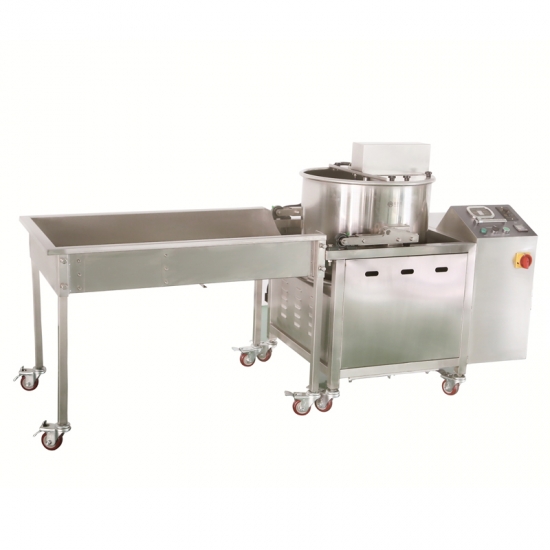
An electromagnetic popping system can be incorporated into a suitable commercial or industrial production workflow.
For larger factories, an industrial popcorn production line can combine multiple processing stages and help reduce unnecessary transfers between machines. XFD's industrial range includes electromagnetic and hot-air production solutions, allowing manufacturers to compare different approaches based on their recipes and operating requirements.
When comparing systems, check the stated output, popping method, ingredient feeding arrangement, cleaning requirements, available floor space, and the expected working hours per day. Rated capacity should be evaluated against the complete production process rather than the popping machine alone.
Add Flavor Through a Controlled Coating Process
After popping, the next step depends on the product being made. Plain salted popcorn may require only seasoning and oil distribution, while caramel, cheese, chocolate, and other flavored products need a coating process suited to their ingredients.
A popcorn coating machine tumbles the popcorn while the coating ingredients are introduced. The movement helps distribute seasonings across the batch. For caramel popcorn, the process may require a dedicated caramelizer or integrated caramelizing equipment to apply and set the coating.
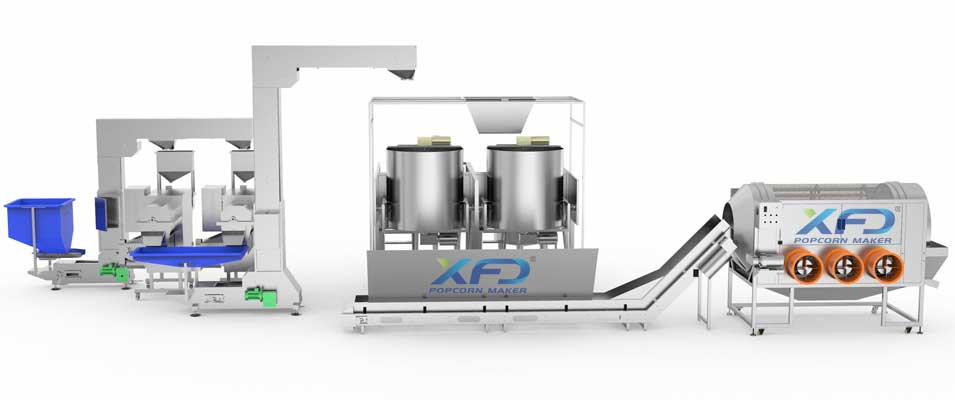
Integrated production equipment can help coordinate popping, coating, and product transfer.
For factories producing several flavors, it is important to consider recipe changeovers, cleaning time, coating uniformity, and how quickly the system can return to production. A popcorn coating, sifting, separating, and cooling machine may combine several finishing functions in one unit, depending on the configuration selected.
The coating recipe should be tested with the actual popcorn variety and ingredients. Too much coating liquid, uneven seasoning distribution, or unsuitable processing conditions can affect the final texture. Equipment settings should therefore be established through production trials rather than assumed to work identically for every flavor.
Cool and Separate the Finished Popcorn
Cooling is an important stage between coating and packaging. Freshly popped or coated popcorn may still be warm, and caramel or other coatings may need time to stabilize. Packing the product before it reaches suitable conditions can lead to clumping, trapped moisture, or a loss of crispness during storage.
A cooling and separation system helps bring the product toward the required packing condition while removing loose coating material and separating pieces where the equipment is designed to perform those functions. Conveyors can transfer the popcorn between stages and reduce repeated manual movement.
For caramel-coated popcorn, cooling conditions should be tested alongside the coating recipe and packaging material. The aim is to achieve a stable coating and a product texture that remains acceptable after packing. Actual cooling time depends on product temperature, batch size, airflow, coating composition, and the surrounding environment.
Inspect Product Quality Before Packaging
Quality checks should take place throughout production, not just at the end of the line. Operators can inspect popped-kernel consistency, unpopped kernels, burnt pieces, coating distribution, foreign material, and finished-product texture. For flavored popcorn, taste, color, and coating coverage should also be checked against the approved product standard.
Factories should establish practical inspection criteria for each product type and keep records of relevant process settings, batch information, and defects. This makes it easier to identify whether a problem originates during popping, flavoring, cooling, or packaging.
The workflow should also include a clear procedure for handling rejected products, cleaning equipment, and preventing cross-contact between recipes where applicable. Food safety requirements must be considered when designing the production area and selecting food-contact materials.
Select Packaging Equipment for the Finished Product
Once popcorn has reached the required condition and passed inspection, it can move to packaging. The packaging system depends on how the product will be sold, the target pack weight, the required production speed, and the shelf-life expectations.
Retail bags, bulk packs, cinema servings, and microwave popcorn products have different packaging needs. Manufacturers should confirm the compatibility of the product, package material, sealing method, and filling equipment before choosing a final configuration.
For example, XFD offers fully automatic popcorn production and coating equipment for factory applications. When planning a complete line, discuss packaging integration separately so the filling and sealing capacity can keep pace with the upstream production stages.
The packaging stage should be sized according to the actual finished-product output. If the packaging machine cannot handle the volume delivered by the cooling section, product may accumulate between stages and slow the whole operation.
How to Balance Capacity Across the Production Line
A production line performs well when its stages work at compatible speeds. A high-capacity popping machine does not automatically create a high-capacity factory if the coating, cooling, inspection, or packaging equipment becomes a bottleneck.
Before purchasing equipment, calculate the expected finished-product output per hour and identify the capacity required at each stage. Consider recipe changes, cleaning breaks, ingredient replenishment, operator availability, and routine maintenance when estimating practical production time.
XFD's industrial systems include different configurations for different output requirements. For instance, the industrial hot-air popcorn line with a coating drum and caramelizer is listed for an output of approximately 180–250 kg/h for caramel or chocolate popcorn. Actual results depend on the product and operating conditions, so confirm the required capacity and configuration with the manufacturer.
It is also worth considering future expansion. A modular system that supports additional popping or coating equipment may make it easier to increase capacity without redesigning the entire workflow. The practical choice depends on the available space, utilities, budget, and expected business growth.
Common Problems in Commercial Popcorn Production
Several problems can interrupt a commercial popcorn production workflow. Identifying where each issue occurs helps the production team correct the cause instead of adjusting unrelated equipment.
- Uneven popping: Check kernel quality, ingredient feeding, and the popping conditions specified for the machine.
- Uneven seasoning: Review coating distribution, tumbler loading, ingredient feeding, and mixing time.
- Burnt caramel: Check heating conditions, recipe preparation, and the time the coating remains exposed to heat.
- Sticky or soft popcorn: Review coating formulation, cooling conditions, ambient humidity, and packaging suitability.
- Product buildup between machines: Compare the output of popping, coating, cooling, and packaging equipment to identify the bottleneck.
- Frequent production stops: Review cleaning procedures, maintenance schedules, ingredient replenishment, and equipment handoffs.
A well-planned workflow makes these problems easier to trace because each stage has a defined function and inspection point. Consistent operating procedures and routine maintenance are just as important as machine capacity when maintaining stable production.
How to Plan a Popcorn Production Line for Your Business
The best production workflow depends on what you make, how much you produce, and how the finished popcorn is sold. A cinema operator, a gourmet popcorn brand, and a large snack food factory may all require different combinations of equipment.
Before requesting a quotation, prepare the following information:
- Target output in kilograms per hour or finished packs per hour.
- Popcorn varieties and flavors, including caramel, cheese, chocolate, or savory seasonings.
- Preferred popping method and the expected level of automation.
- Available factory space, power supply, and other utility requirements.
- Required cooling, separation, conveying, and packaging functions.
- Cleaning procedures, food safety requirements, and plans for future capacity expansion.
With these details, the equipment supplier can assess the workflow as a connected system instead of recommending machines based on output figures alone. XFD provides commercial and industrial popcorn equipment for different production applications. You can review the available industrial popcorn machines and production lines to identify a suitable starting point for your project.
Frequently Asked Questions About Commercial Popcorn Production
What are the main stages of commercial popcorn production?
The main stages are raw material preparation, popping, flavor coating, cooling and separation, quality inspection, and packaging. The exact workflow depends on the popcorn recipe, output target, and equipment configuration.
What equipment is needed for a commercial popcorn production line?
A typical line may include a popcorn popping machine, ingredient feeding equipment, a coating machine or caramelizer, conveyors, cooling and separation equipment, and packaging machinery. Not every factory needs every component; equipment should be selected according to the product and production requirements.
What is the difference between commercial and industrial popcorn equipment?
Commercial popcorn machines are commonly used in cinemas, concession stands, and retail venues. Industrial popcorn equipment is designed for larger production operations and can incorporate integrated feeding, popping, coating, cooling, and other processing stages.
How do you make caramel popcorn on a commercial scale?
Commercial caramel popcorn production generally involves popping the kernels, preparing the caramel coating, applying the coating with suitable equipment, and cooling the product before inspection and packaging. Recipe, temperature, coating distribution, and cooling conditions must be controlled to achieve a consistent result.
Why is cooling important before packaging popcorn?
Cooling helps stabilize the product before packing. Packaging popcorn while it is too warm can contribute to condensation, clumping, or texture problems, depending on the coating and packaging conditions.
How do you choose the right popcorn production line capacity?
Start with the required finished-product output per hour, then check the capacity of the popping, coating, cooling, and packaging stages. Include cleaning, recipe changes, replenishment, and planned downtime when estimating practical output.
Can a popcorn production line be expanded in the future?
Some systems support expansion by adding popping or coating equipment. Before choosing a modular line, confirm the available space, utility capacity, control-system compatibility, and whether downstream equipment can handle the additional output.
Does every popcorn factory need a fully automatic production line?
No. Smaller producers may use individual machines or semi-automatic equipment, while larger factories may benefit from automation to coordinate production stages and reduce manual handling. The right option depends on output, labor availability, product range, and budget.
A reliable commercial popcorn production workflow connects each stage from raw materials to finished packs. By matching popping, coating, cooling, quality control, and packaging capacity, manufacturers can improve process consistency and prepare for future growth. XFD's commercial and industrial popcorn equipment provides options for businesses planning a new line or upgrading an existing production process.


