Categories
New Blog
Your Ultimate Guide to Commercial Popcorn Machine Care and Cleaning
Commercial popcorn machines are built for repeated use, but regular care is still essential. Oil, sugar, seasoning residue, popcorn kernels, and moisture can gradually build up around the kettle, heating area, doors, trays, and other working parts. If these residues are left for too long, cleaning becomes more difficult and machine performance may be affected.
So, how do you clean and maintain a commercial popcorn machine properly?
The simple answer is to clean food-contact areas after each operating day, remove oil and popcorn residue before it hardens, keep electrical components away from water, and perform deeper maintenance according to the machine manufacturer's instructions.
For businesses choosing equipment for cinemas, concession stands, snack shops, stadiums, entertainment venues, and gourmet popcorn stores, maintenance should also be considered when selecting a machine. XFD offers different commercial popcorn machine designs, including electric-heated and electromagnetic-heated models, with options designed around easier operation and maintenance. Explore XFD Commercial Popcorn Machines
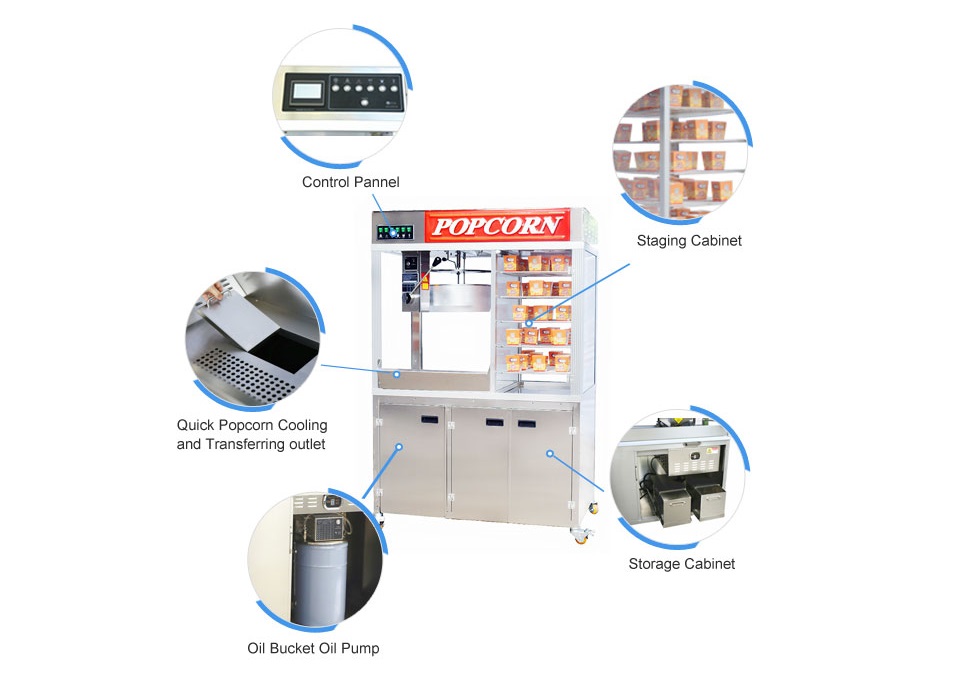
Commercial popcorn equipment with integrated popping, cooling, storage, and display functions.
A popcorn machine may look clean from the outside while grease and seasoning residue are building up around the kettle and other high-use areas. This is particularly common in busy commercial locations where the machine operates continuously during movie sessions, events, lunch periods, or peak shopping hours.
Regular cleaning helps keep the equipment presentable, supports food hygiene practices, and makes daily operation easier for staff. It can also make it easier to notice loose parts, damaged electrical cables, unusual residue, or other maintenance issues before they become larger problems.
For high-volume operators, maintenance is not simply about appearance. A popcorn machine is part of the production process. Keeping the kettle, heating area, cooling area, and working surfaces clean can help maintain a more consistent operating routine.
XFD's product range includes commercial popcorn machines for different operating environments, while its equipment designs also include features such as automatic kettle cleaning on selected models. For example, the 48 oz Deluxe Convertible Floor Model is described by XFD as having an auto kettle-cleaning function and a washable residue filter. See the XFD 48 oz Deluxe Convertible Floor Model
Not every component should be cleaned in the same way. Before starting, separate the machine into areas that come into direct contact with food, removable components, external surfaces, and electrical or mechanical components.
The exact cleaning points depend on the machine structure. For example, some XFD models combine the popcorn maker with a cooling table, oil pump, exhaust system, and control panel, so the cleaning routine should follow the specific machine configuration rather than a generic checklist.
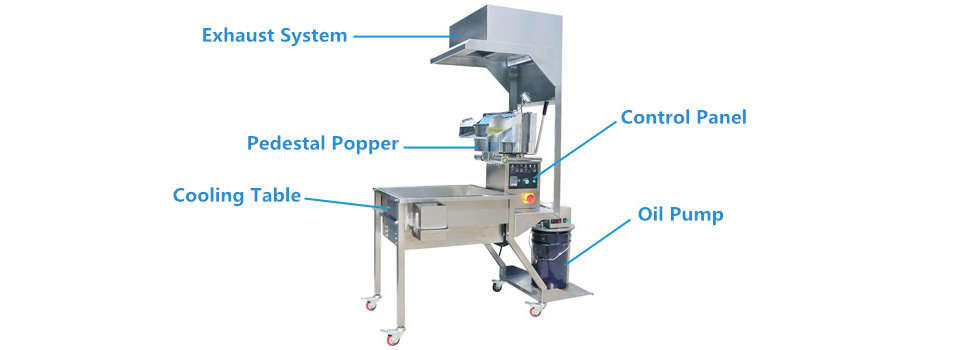
Typical popcorn machine components that should be considered during daily inspection and maintenance.
The best cleaning routine is one that staff can repeat every day. A simple procedure is usually easier to follow than a complicated cleaning process that gets skipped during busy periods.
Step 1: Turn off and disconnect the machine.
Always switch the machine off and follow the manufacturer's shutdown procedure before cleaning. Allow hot components to cool to a safe handling temperature. Never begin wiping or washing a hot kettle with cold water unless the equipment manual specifically allows that procedure.
Step 2: Remove leftover popcorn and loose debris.
Empty the machine, remove unpopped kernels, and clear loose popcorn from the deck, trays, corners, and surrounding areas. Doing this before grease hardens makes the rest of the cleaning process much easier.
Step 3: Clean the kettle.
The kettle normally requires the most attention because oil and seasoning can stick to its surface. Follow the cleaning method specified for your particular kettle. Some XFD models include automatic kettle-cleaning functions, but operators should still follow the model-specific operating instructions rather than assuming every popcorn machine has the same cleaning procedure.
Step 4: Clean removable trays and food-contact parts.
If a component is designed to be removed for cleaning, take it out carefully and clean it separately. Use an appropriate food-safe cleaning method, rinse where required, and allow the component to dry completely before putting it back.
Step 5: Wipe the glass and exterior.
Clean glass panels and external surfaces with a suitable cleaner and cloth. Avoid spraying cleaning chemicals directly toward switches, control panels, motors, electrical connections, or other openings.
Step 6: Inspect before restarting.
Before the next production cycle, make sure removable parts are correctly installed, surfaces are dry, the kettle is properly positioned, and there is no cleaning residue remaining in food-contact areas.
For most commercial operations, cleaning should be divided into daily, weekly, and periodic maintenance tasks. The exact frequency depends on production volume, ingredients, operating hours, and machine design.
| Maintenance Task | Recommended Frequency | What to Check |
|---|---|---|
| Remove popcorn and loose debris | After each operating day | Kettle, deck, trays, corners |
| Clean kettle and food-contact surfaces | Daily / according to usage | Oil, sugar, seasoning, carbonized residue |
| Clean glass and exterior | Daily | Grease, fingerprints, food residue |
| Inspect filters and exhaust areas | Weekly or according to usage | Grease buildup and blockage |
| Inspect electrical and mechanical components | Periodically | Cables, connections, moving parts, abnormal noise |
This schedule is a practical starting point rather than a replacement for the manufacturer's maintenance instructions. A machine operating for several hours every day may require more frequent cleaning than a small popcorn machine used only occasionally.
Oil and sugar are two of the most common sources of stubborn residue in popcorn equipment. Oil can leave a greasy film, while sugar-based recipes can create sticky deposits that become harder to remove after repeated heating.
The practical approach is to avoid allowing residue to accumulate for several days. Remove loose material first, then clean the affected food-contact surfaces using the cleaning method approved for the equipment.
For caramel, cheese, or other flavored popcorn production, the cleaning requirement may be different from traditional salted popcorn. This is one reason operators using multiple flavors should establish a cleaning routine based on the actual ingredients being processed.
For businesses producing flavored popcorn at higher volumes, XFD also offers dedicated seasoning and coating equipment. Explore XFD Popcorn Coating and Seasoning Equipment
Some cleaning problems are caused not by insufficient cleaning, but by using the wrong method.
Cleaning should be considered before purchasing a commercial popcorn machine, not after the equipment has already been installed.
Look for practical features such as removable components, accessible cleaning areas, stainless-steel food-contact surfaces, washable filters where applicable, automatic cleaning functions, and a layout that allows staff to reach commonly used areas without dismantling the entire machine.
XFD's commercial range includes compact tabletop models as well as larger floor models for cinemas, snack shops, venues, and other commercial applications. Some models are specifically described as easy to clean, while selected machines incorporate automatic kettle-cleaning functions.
For cinema operators with different production requirements, XFD also provides a dedicated Cinema Popcorn Machine range covering different machine configurations and heating technologies.
If several employees operate the same machine, a short checklist can make cleaning more consistent. A practical closing checklist can include:
For self-service popcorn operations, cleaning should also include the dispensing and holding area. XFD offers staging and self-service equipment designed for commercial popcorn presentation and dispensing. View XFD Popcorn Staging Cabinets
A clean machine is important, but preventive maintenance goes beyond wiping surfaces.
Operators should periodically check the condition of power cords, switches, control panels, moving components, filters, exhaust systems, oil-feeding systems, and other parts identified in the equipment manual. Any unusual noise, overheating, inconsistent heating, oil leakage, or control problem should be investigated before continuing normal production.
For larger popcorn production facilities, maintenance becomes even more important because multiple machines may operate as part of a continuous process. XFD's industrial range includes popcorn production, coating, and packing solutions designed for larger-scale operations.
The right maintenance plan therefore depends on the equipment type. A 16 oz tabletop popcorn machine, a 48 oz commercial popper, a cinema production machine, and an industrial popcorn production line should not necessarily follow exactly the same maintenance schedule.
How often should a commercial popcorn machine be cleaned?
A commercial popcorn machine should generally receive basic cleaning after each operating day, with deeper cleaning and equipment inspection performed according to usage and the manufacturer's instructions. High-volume machines may require more frequent attention.
Can you wash a commercial popcorn machine with water?
Do not wash the entire machine with water. Electrical components, motors, control panels, switches, and wiring must be protected from water. Only removable components that are specifically designed for washing should be cleaned using an appropriate method.
How do you clean a popcorn machine kettle?
First switch off the machine and allow the kettle to cool safely. Remove loose popcorn and residue, then follow the kettle-cleaning procedure specified by the manufacturer. Some XFD popcorn machines include automatic kettle-cleaning functions, but the exact procedure depends on the model.
How do you remove burnt popcorn residue?
Do not rely on aggressive scraping as the first solution. Remove loose residue, then use the cleaning method recommended for the specific kettle material and machine. If residue has become heavily carbonized, follow the manufacturer's deep-cleaning procedure.
Should the glass of a popcorn machine be cleaned every day?
Yes. Glass panels can collect fingerprints, oil mist, dust, and popcorn residue during normal operation. Daily cleaning keeps the display clearer and gives the machine a cleaner appearance in front of customers.
What should be checked besides cleaning?
Operators should periodically inspect electrical connections, cables, filters, exhaust areas, moving components, oil-feeding systems, and other model-specific parts. Unusual noise, overheating, leakage, or inconsistent operation should not be ignored.
Does an easy-to-clean popcorn machine reduce maintenance work?
It can make routine maintenance more convenient, especially when the machine has accessible food-contact areas, removable components, washable filters, or an automatic kettle-cleaning function. However, the machine still needs a consistent cleaning and inspection routine.
Keeping a commercial popcorn machine clean is mainly about consistency. Clean the kettle and food-contact areas regularly, remove oil and seasoning residue before it builds up, keep electrical components dry, and inspect the machine according to the manufacturer's instructions.
When choosing a commercial popcorn machine, it is worth looking beyond popping capacity and heating method. Easy access to cleaning areas, removable parts, and routine maintenance can also make a difference in day-to-day operation.
 No.58 TongMing Road,TongAn District,XiaMen City,FuJian Province
 +86-592-5701935
If you are interested in any XFD product, please leave us a message, we will reply to you soon.
Copyright © 2012-2026 XFD XIAMEN MACHINERY TECHNOLOGY LTD..All Rights Reserved.
 English
 Deutsch
 русский
 español
 português
 Nederlands
 العربية
 हिंदी
हिंदी