Categories
New Blog
For popcorn manufacturers, reducing product loss is one of the most practical ways to improve production efficiency and control operating costs. During high-volume production, even a small amount of wasted popcorn in every batch can become a significant loss over a full production shift. Unpopped kernels, broken popcorn, excessive coating residue, product spillage, and packaging defects can all reduce the amount of saleable finished product.
So, how can popcorn manufacturers reduce product loss during high-volume production? The most effective approach is to control losses at every processing stage, from raw material preparation and popping to conveying, cooling, coating, and packaging. Manufacturers should also monitor actual finished-product yield instead of evaluating production performance only by the output of the popping machines.
For industrial snack factories, a properly configured industrial popcorn production system can help coordinate these processes, reduce unnecessary manual handling, and improve production consistency. XFD offers popcorn machinery and integrated production equipment for manufacturers with different output requirements.
Product loss can occur at almost every stage of popcorn manufacturing. Some losses are caused by raw material quality, while others result from equipment settings, product handling, or an imbalance between processing stages. Identifying the source of the loss is the first step toward reducing it.
The most common sources of product loss in an industrial popcorn factory include:
These losses are often connected. For example, excessive breakage during conveying may increase the amount of small fragments removed during filtering. Similarly, inconsistent coating can lead to product rejection during final inspection. Manufacturers should therefore evaluate the complete production process instead of treating each problem as an isolated issue.
Raw material quality has a direct influence on popcorn yield. Even a well-designed industrial popcorn machine cannot achieve consistent results when the incoming kernels vary significantly in moisture content, size, maturity, or popping performance.
When kernels contain unsuitable moisture levels, they may not pop consistently. Some remain unpopped, while others produce smaller or irregular popcorn pieces. Damaged kernels and excessive foreign materials can also increase sorting and cleaning requirements.
Manufacturers can reduce raw material-related losses by following several practical measures:
Storage management is equally important. Corn kernels exposed to excessive moisture or unsuitable storage conditions may experience quality changes that affect popping performance. Proper inventory rotation also helps manufacturers avoid using old or poorly stored materials without inspection.
For large factories, automated ingredient feeding can further improve material control. A stable feeding system helps deliver a consistent quantity of kernels and cooking oil to the popping equipment, reducing interruptions caused by irregular manual feeding.
Unpopped kernels and burnt popcorn are two common sources of loss during high-volume production. They reduce the amount of usable finished product and may also affect the appearance and eating quality of the final snack.
Popping performance depends on several factors, including kernel moisture, heating consistency, oil supply, batch size, and processing time. If these factors are not properly matched, the popping process may produce an inconsistent mixture of fully popped kernels, unpopped corn, and damaged pieces.
To improve popping yield, manufacturers should focus on the following areas:
Maintain stable heating conditions. Uneven heating can cause some kernels to pop earlier than others. Operators should follow the equipment manufacturer's recommended operating parameters and monitor actual production results.
Control ingredient feeding. Feeding too many kernels into a kettle may reduce heating consistency, while an insufficient feed rate can lower equipment utilization. The batch size should match the machine's design and operating conditions.
Check oil delivery. Inconsistent oil supply can affect heat transfer and product consistency. Automated oil feeding and suitable oil temperature management can help maintain more repeatable processing conditions.
Monitor popping performance. Record unpopped kernel quantities, burnt pieces, and finished output. If the defect rate increases, investigate the raw material batch and machine settings before changing several process parameters at once.
XFD's industrial popcorn production and coating line uses electromagnetic popping technology and includes automatic oil feeding, oil heating preservation, and kettle-dumping systems. The listed configuration has a popping capacity of approximately 60–80 kg/h. These features help organize the popping process and reduce unnecessary manual operations, while actual yield still depends on kernel quality and production settings.
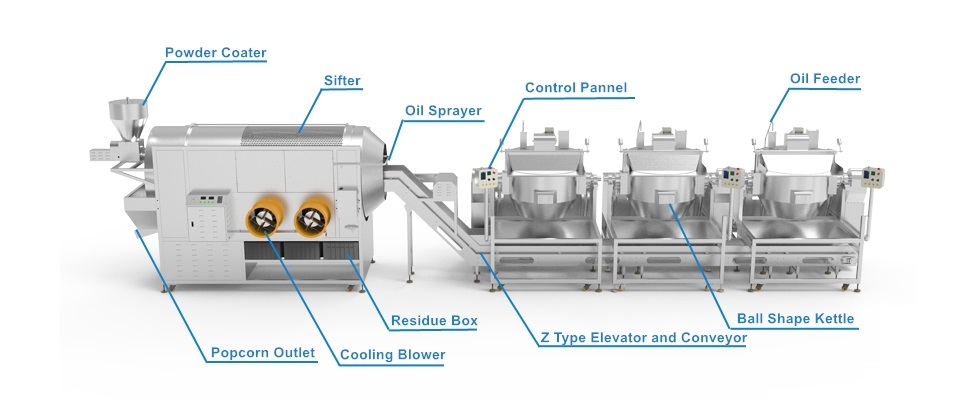
Integrated popcorn processing equipment helps coordinate popping, ingredient feeding, conveying, and coating.
Conveying is sometimes overlooked when manufacturers investigate production losses. However, popcorn passes through multiple transfer points in a high-volume factory. Every unnecessary transfer creates another opportunity for spillage, breakage, and product accumulation.
For example, popcorn may fall from an open transfer point when moving from a popping machine to a cooling system. If a conveyor is not correctly positioned, product may collect around the equipment or become difficult to recover. Excessive conveyor speed, unsuitable transfer heights, and abrupt changes in direction can also increase mechanical damage.
Manufacturers can reduce conveying losses through several improvements:
For delicate popcorn varieties, gentle product transfer is especially important. Excessive impact can break the expanded kernels into small fragments, reducing the amount of visually acceptable finished product. Mushroom popcorn and large gourmet popcorn varieties may require particular attention because their shape and size influence how they move through the equipment.
XFD production systems can incorporate Z-type elevators and conveyors to transfer popcorn between processing stages. Manufacturers should confirm conveyor dimensions, transfer height, speed, and capacity when planning a complete line. The goal is to maintain a steady product flow without unnecessary handling or accumulation.

Suitable conveyor design helps reduce unnecessary product handling during factory production.
Cooling and filtering are important for maintaining product quality before coating or packaging. This stage helps reduce product temperature and separate unpopped kernels, small fragments, and other unwanted materials from the finished popcorn.
However, incorrect filtering settings may also cause unnecessary product loss. If the screen openings are unsuitable or the separation process is too aggressive, usable popcorn may be removed together with unwanted particles. Excessive vibration or unsuitable material handling can also increase breakage.
To improve separation efficiency without discarding too much usable product, manufacturers should:
A well-matched popcorn cooling and filtering machine can help manufacturers separate unwanted materials while cooling the product. XFD's equipment uses a rotating drum screen and multiple cooling blowers. Its published specifications describe adjustable rotation and separation functions, making the configuration suitable for evaluation in industrial popcorn processing lines.
One practical method is to collect the rejected materials during a production trial and inspect them manually. If a significant amount of acceptable popcorn is being removed, the screen size, rotation speed, and feeding rate may need adjustment.
Coating waste can become a significant cost for factories producing caramel, cheese, chocolate, and other flavored popcorn. Sugar syrup, oil, and seasoning powders are valuable ingredients. When too much coating remains inside the equipment or falls away from the popcorn, material costs increase without improving the finished product.
Uneven coating application is another source of loss. Some kernels may receive too much coating, while others remain undercoated. This creates inconsistent products and may lead to additional sorting or reprocessing.
Manufacturers can improve coating efficiency through the following methods:
Control the coating ratio. Measure the quantity of syrup, oil, and seasoning used in each batch. Avoid increasing the coating amount simply to improve appearance when the actual problem is uneven distribution.
Maintain consistent ingredient feeding. Controlled feeding helps distribute coating materials more evenly and reduces excessive deposits in specific areas of the equipment.
Match mixing speed to the product. Excessive mixing can break popcorn, while insufficient mixing may produce uneven coverage. Test the appropriate mixing conditions for each recipe.
Reduce changeover waste. Plan production batches and flavor changeovers carefully. Appropriate cleaning and ingredient preparation procedures can reduce the amount of coating material discarded between products.
For factories producing multiple flavors, XFD's popcorn coating and seasoning machines include different solutions such as caramelizers and rotating coating tumblers. Equipment should be selected according to whether the recipe requires cooked caramel, liquid coating, or dry seasoning powder.
Manufacturers should also distinguish between normal ingredient consumption and actual coating waste. Some coating remains on equipment surfaces during operation and cleaning, but excessive residue may indicate unsuitable equipment design, incorrect feeding, or an inefficient cleaning procedure.
Packaging is the final stage before popcorn is ready for storage and distribution, but it can still create substantial product losses. Incorrect filling weights, damaged bags, poor sealing, and product spillage may result in finished goods that cannot be sold as intended.
For example, if the filling system consistently adds more popcorn than the target package weight, the factory gives away extra product in every bag. Although the difference in an individual package may appear small, the total over thousands of packages can be considerable.
Common packaging problems include:
To reduce these losses, manufacturers should regularly check weighing accuracy, filling speed, sealing temperature, and packaging material quality. Finished packages should also be inspected to identify leakage, poor seals, or other defects before shipment.
XFD offers popcorn packaging machines for different packaging requirements. When choosing a packing system, manufacturers should confirm the target bag weight, packaging material, bag dimensions, filling accuracy, and required packing speed.
It is equally important to coordinate packaging capacity with the output of the popping, cooling, and coating stages. If packaging is slower than upstream production, finished popcorn may accumulate and require additional handling, increasing the risk of breakage and product deterioration.
A common mistake in high-volume popcorn production is selecting each machine according to its individual capacity without checking whether the complete production line can operate at a balanced rate.
For example, a factory may install several high-capacity popping machines but use a cooling system that cannot process the same amount of popcorn. The result is product accumulation between stages, production interruptions, and additional handling. Similar problems can occur when the coating or packaging equipment becomes the slowest part of the line.
A balanced production line should consider:
The effective output of a complete production line is usually limited by its slowest processing stage. Manufacturers should therefore compare actual hourly output at every major stage rather than relying only on the rated capacity of the popping equipment.
Integrated equipment arrangements can reduce unnecessary transfers and make it easier to coordinate the production process. XFD's industrial popcorn systems combine different processing components according to the selected configuration, helping manufacturers plan a more connected workflow.
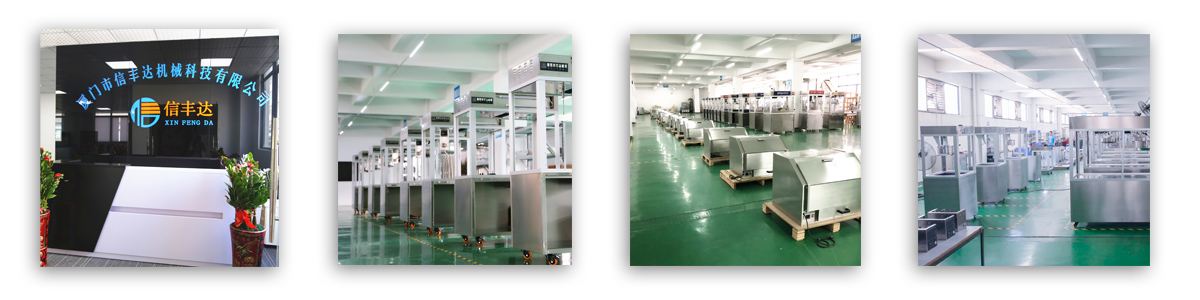
Industrial equipment planning and production coordination are important for consistent manufacturing performance.
Manufacturers cannot improve production yield accurately without measuring how much material is lost. Instead of relying on general observations, factories should establish a simple system for recording material input, finished output, and waste at each processing stage.
One useful measurement is the finished-product yield rate:
Finished Product Yield (%) = Saleable Finished Product Weight ÷ Total Relevant Material Input Weight × 100
The calculation must use a clearly defined production boundary. For example, if the purpose is to evaluate popping performance, compare popped popcorn with the incoming kernel weight. If the purpose is to evaluate the complete manufacturing process, account for all relevant ingredients and distinguish normal moisture loss from recoverable waste and rejected finished products.
Manufacturers should also track several individual indicators:
For example, a factory processing 500 kg of popcorn per shift should record how much becomes saleable finished product and how much is removed as unpopped kernels, fragments, coating waste, or rejected goods. Comparing these records over several shifts can help identify which stage deserves the most attention.
It is important not to treat every reduction in product weight as waste. Moisture evaporation during popping and cooling is a normal part of food processing. The goal is to reduce avoidable material loss while maintaining the required product quality and food safety standards.
Automation can help reduce product loss by making ingredient feeding, popping, transferring, cooling, coating, and packaging more consistent. It also reduces some repetitive manual operations that may cause uneven handling or unnecessary product movement.
For example, automatic oil feeding can help maintain a more consistent supply of cooking oil. Automatic discharge systems can reduce manual unloading, while conveyors can transfer popcorn between machines without repeated hand handling.
An integrated production line may provide several practical advantages:
However, automation alone does not guarantee lower product loss. Equipment must be correctly selected, installed, and maintained. Incorrect screen settings, unsuitable conveyor speeds, or poorly adjusted coating systems can still create waste even in a fully automatic factory.
Manufacturers should evaluate the complete production process before upgrading individual machines. A properly matched system is generally more effective than adding automation to only one stage while leaving the rest of the production line unchanged.
Reducing product loss requires more than improving one machine. Manufacturers need to consider how raw materials, popping equipment, conveyors, cooling systems, coating machines, and packaging equipment work together as a complete production process.
XFD provides popcorn machinery and production equipment for different factory requirements, including industrial electromagnetic popping systems, cooling and filtering machines, coating equipment, and packaging solutions. These equipment options can be evaluated according to the required output, popcorn varieties, coating methods, and level of automation.
When requesting an equipment proposal, manufacturers should provide the following information:
This information helps identify which processing stages need improvement and whether an individual machine or a more integrated production line is appropriate.
For manufacturers planning a new factory or upgrading existing equipment, visit XFD Popcorn to explore industrial popcorn equipment and production solutions. The right equipment configuration, combined with consistent quality monitoring, can help reduce avoidable product waste and improve long-term production efficiency.
How can popcorn manufacturers reduce product loss during high-volume production?
Manufacturers should control raw material quality, improve popping consistency, reduce conveyor spillage, optimize cooling and filtering, control coating application, and improve packaging accuracy. Monitoring product loss at each processing stage helps identify the most important areas for improvement.
What causes high waste rates in industrial popcorn production?
Common causes include poor kernel quality, excessive unpopped kernels, burnt popcorn, mechanical breakage, conveyor spillage, inefficient filtering, coating residue, and packaging defects. Production capacity mismatches can also increase handling and product waste.
How can manufacturers reduce unpopped kernels in popcorn production?
Use suitable popcorn kernels, maintain appropriate storage conditions, control ingredient feeding, and follow the recommended heating and operating parameters of the popping machine. Regularly recording unpopped kernel quantities can help identify changes in raw material quality or machine performance.
Can conveyor systems reduce popcorn breakage and product spillage?
Yes. Properly selected conveyors can reduce repeated manual handling and provide more controlled product transfer. Suitable conveyor speed, transfer height, connection design, and equipment capacity are important for limiting spillage and mechanical damage.
How does a cooling and filtering machine help reduce popcorn production waste?
A cooling and filtering machine helps reduce product temperature and separate unpopped kernels, small fragments, and unwanted materials. Appropriate screen openings and operating settings are important to prevent usable popcorn from being removed unnecessarily.
How can popcorn manufacturers reduce coating material waste?
Manufacturers should control the coating-to-popcorn ratio, maintain consistent ingredient feeding, optimize mixing conditions, and reduce unnecessary coating residue during production and cleaning. The coating equipment should also match the recipe and production capacity.
How can packaging equipment reduce finished popcorn loss?
Accurate weighing, controlled filling, reliable sealing, and suitable packaging speed can reduce product giveaway, spillage, damaged packages, and rejected finished goods. Packaging capacity should match the output of the upstream production line.
How do manufacturers calculate popcorn production yield?
Finished-product yield can be calculated by dividing the weight of saleable finished product by the relevant total material input weight and multiplying by 100. The calculation should use a consistent production boundary and distinguish normal moisture loss from avoidable waste.
 No.58 TongMing Road,TongAn District,XiaMen City,FuJian Province
 +86-592-5701935
If you are interested in any XFD product, please leave us a message, we will reply to you soon.
Copyright © 2012-2026 XFD XIAMEN MACHINERY TECHNOLOGY LTD..All Rights Reserved.
 English
 Deutsch
 русский
 español
 português
 Nederlands
 العربية
 हिंदी