Categories
New Blog
Uneven caramel coating is a common quality problem in large-scale popcorn production. Some popcorn pieces may be covered with a thick layer of caramel, while others remain pale, lightly coated, or almost plain. In severe cases, caramel forms sticky clusters instead of separating into evenly coated pieces.
For popcorn factories, this problem affects more than appearance. Inconsistent coating can lead to uneven sweetness, different textures, product waste, and complaints about batch consistency. When the problem occurs repeatedly, it may also indicate that the caramel recipe, heating conditions, mixing process, or production line configuration needs adjustment.
The most common causes of uneven caramel coating are inconsistent caramel viscosity, incorrect ingredient ratios, unstable heating, poor mixing action, uneven popcorn feeding, and insufficient control of cooling. Manufacturers should identify where the coating process becomes inconsistent before changing the recipe or increasing production speed.
For factories producing caramel popcorn at commercial scale, XFD provides industrial popcorn production equipment and integrated processing solutions designed to coordinate popping, coating, conveying, and cooling operations.
Uneven caramel coating usually occurs when the caramel mixture and popcorn do not interact consistently during mixing. The caramel may be too thick to spread, too fluid to remain evenly distributed, or delivered faster than the mixing equipment can disperse it.
Several conditions can contribute to the problem:
These causes can produce similar-looking defects, so operators should not assume that every coating problem can be solved by increasing the caramel temperature. The correct adjustment depends on the actual cause and the recipe being used.
Caramel temperature affects how easily the coating mixture flows, spreads, and adheres to popcorn. If the mixture becomes too viscous, it may form thick strands or clumps instead of distributing evenly. If its temperature and formulation are not properly controlled, the coating may also set inconsistently across the batch.
However, increasing the temperature is not always the right solution. Excessive heating can darken the caramel, create unwanted bitter flavors, or cause localized scorching. The appropriate operating temperature depends on the ingredients, moisture content, heating system, and processing method.
Factories should establish a repeatable temperature range through recipe trials and equipment testing rather than relying on visual judgment alone.
Useful checks include:
For industrial production, an appropriate industrial caramel cooker and coater can help operators manage heating and mixing more consistently. XFD's large caramelizer uses an adjustable electromagnetic heating system and a digital temperature display. These features support process control, although consistent coating still depends on the recipe and operating settings.
 Mixing components in an industrial cooker and coater help distribute the coating mixture during processing.
Yes. The caramel formulation has a direct influence on coating flow, adhesion, and setting behavior. Even when the equipment operates consistently, changes in ingredient proportions can produce noticeably different results.
Sugar is the primary source of caramel flavor, but commercial formulations may also contain fats, glucose syrup, or other ingredients depending on the product specification. These components affect the behavior of the heated mixture, so changing one ingredient can influence the entire coating process.
For example, a caramel mixture that is too thick may collect on a small number of popcorn pieces. A formulation that remains excessively fluid under the chosen processing conditions may distribute differently or require more control during cooling.
To improve batch consistency, manufacturers should:
Factories using prepared caramel coating ingredients should also follow the supplier's recommended application method. XFD offers caramel coating sugar for popcorn production. The suitability of this ingredient depends on the intended recipe and equipment, so manufacturers should confirm its use instructions before changing an established industrial formulation.
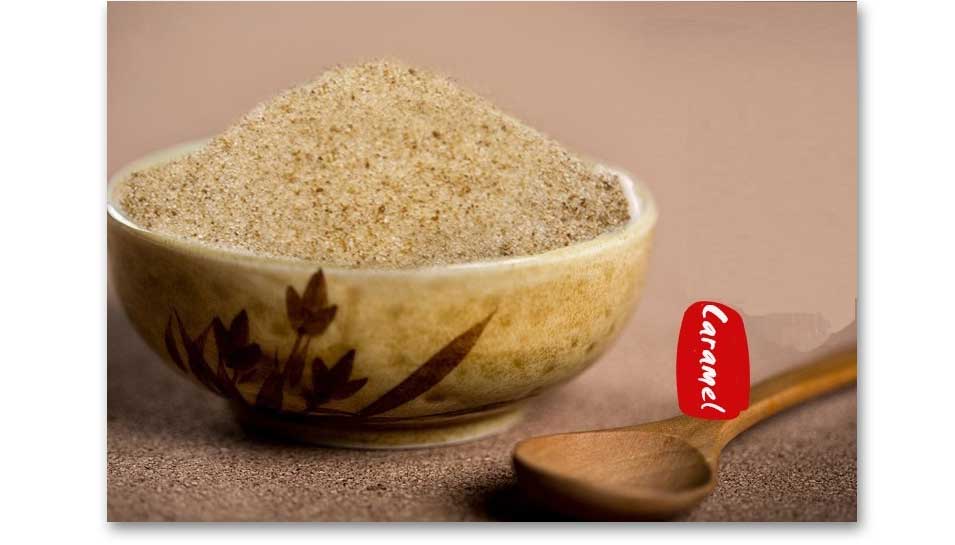 Consistent coating ingredients and accurate formulation are important for repeatable caramel popcorn production.
Mixing is one of the most important stages in caramel popcorn production. The equipment must move popcorn through the coating mixture so that caramel reaches the product surface without excessive breakage or the formation of large sticky clusters.
If the mixing action is too weak, caramel may remain concentrated in certain areas of the batch. If the process is too aggressive, fragile popcorn pieces may break, increasing fines and reducing the visual quality of the finished product.
The goal is not simply to mix faster. It is to achieve sufficient and consistent product movement while allowing the caramel to spread across the popcorn surface.
When troubleshooting mixing problems, check the following:
For large-scale manufacturing, XFD's industrial hot-air popcorn and coating line combines popping and downstream coating equipment. The configuration includes a large caramelizer and coating drum, with modular design options for factories that need to expand production capacity.
Equipment selection should consider the caramel recipe, required throughput, coating method, cleaning needs, and the characteristics of the popcorn being processed. A coating system designed for dry seasoning should not automatically be assumed suitable for every heated caramel formulation.
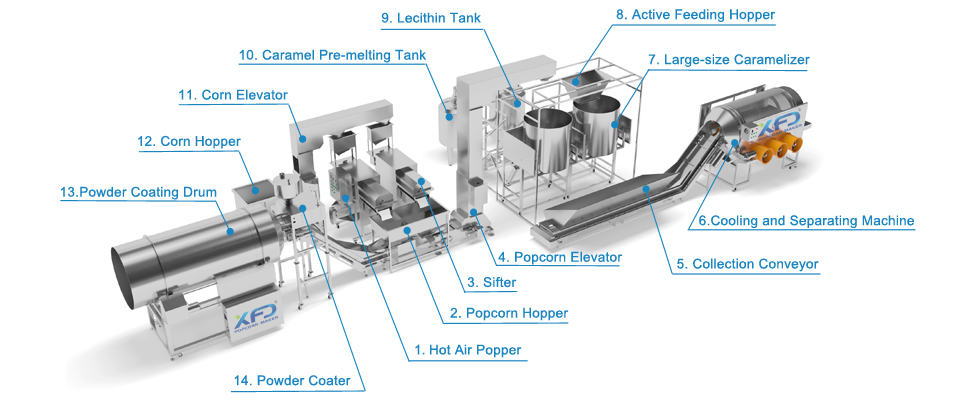 An integrated industrial popcorn line coordinates popping, feeding, coating, and cooling stages.
Even a well-designed caramelizer can produce uneven results if popcorn enters the machine too quickly or too inconsistently. When the coating equipment receives more product than it can mix effectively, caramel may not have enough time to reach every piece.
For example, a batch may appear evenly coated near the beginning of a production run but become increasingly inconsistent as the feeding rate rises. This can happen when the amount of popcorn entering the machine exceeds the effective mixing capacity under the current recipe and operating conditions.
Operators should compare the feeding rate with the coating machine's actual processing capability. The rated capacity of the popping equipment should not be treated as the guaranteed capacity of the coating stage.
To improve feeding consistency:
If uneven coating appears only at higher throughput, temporarily reducing the feeding rate can help determine whether the problem is related to equipment loading. If coating becomes consistent again, the factory should review the balance between feeding speed, mixing performance, and caramel delivery before increasing output further.
Cooling determines how the caramel coating sets after mixing. If the product cools too quickly before the coating has distributed properly, some areas may retain thick deposits while other pieces remain lightly covered. If cooling is delayed or poorly controlled, the popcorn may remain sticky for longer than expected.
Cooling should therefore be coordinated with the coating process rather than treated as an unrelated downstream operation.
Factories should check:
Excess moisture, unsuitable cooling conditions, or packaging the product before it is ready can also affect the final texture. However, sticky popcorn does not always indicate uneven coating; the formulation, cooling process, and packaging conditions should be checked separately.
For industrial operations, the XFD industrial popcorn equipment range provides a starting point for evaluating production configurations that integrate popping with downstream processing. Buyers should confirm the cooling equipment and its capacity for the specific line they plan to purchase.
The fastest way to identify the cause is to examine the coating at different points in the process and change one variable at a time. Adjusting the recipe, temperature, mixing speed, and feeding rate simultaneously makes it difficult to determine which change actually improves the result.
| Observed Problem | Possible Cause | Recommended Check |
|---|---|---|
| Thick caramel clumps | High viscosity, uneven addition, or insufficient mixing | Check temperature, recipe, addition rate, and mixing action. |
| Some pieces have little coating | Poor product circulation or excessive batch loading | Inspect loading level, mixing pattern, and feeding consistency. |
| Coating becomes darker during production | Excessive heating or extended heating time | Verify actual product temperature and heating duration. |
| Coating is sticky after cooling | Moisture, formulation, cooling, or packaging issues | Check recipe consistency, cooling conditions, and storage protection. |
| Quality declines at higher output | Feeding rate exceeds effective coating capacity | Compare feeding speed with mixing and cooling performance. |
After identifying a likely cause, conduct a controlled production trial. Record the recipe, actual temperature, batch size, feeding rate, mixing settings, and coating results. Compare the percentage of evenly coated popcorn before and after the adjustment.
For example, a factory can inspect a representative sample from each trial and record the number of pieces with acceptable coverage, excessive caramel deposits, or insufficient coating. Using the same sampling method makes it easier to compare results across production runs.
The objective is to establish a repeatable operating procedure rather than relying on individual operators to judge the coating by appearance alone.
When uneven coating continues despite stable ingredients and controlled operating conditions, the factory may need to evaluate whether its existing equipment is suitable for the required output.
An industrial caramelizer should provide a mixing arrangement suitable for the recipe, a heating system that supports consistent process control, and sufficient capacity for the intended production volume. The coating stage must also work in coordination with the popping and cooling equipment.
XFD's large caramelizer is designed for industrial snack production and includes an agitator blade, helical impeller, mixing baffles, and adjustable electromagnetic heating. The product page lists an output of 210 kg/h for coated popcorn under its stated configuration. This specification should be verified against the intended product and operating conditions before being used for production planning.
For factories producing caramel popcorn at higher volumes, an integrated industrial popcorn popping and coating line can help coordinate product feeding, caramelizing, conveying, and cooling.
Before choosing a system, buyers should confirm the following details with the equipment supplier:
Where possible, ask the supplier to test the equipment using the intended recipe and agree on practical quality criteria for coating coverage, product damage, and finished-product output. This gives the factory a more reliable basis for equipment selection than rated capacity alone.
Why does caramel coating become uneven during large-scale popcorn production?
Uneven caramel coating commonly results from inconsistent caramel viscosity, unstable heating, incorrect ingredient proportions, insufficient mixing, excessive feeding speed, or poorly coordinated cooling. Factories should identify the main cause before changing the recipe or equipment settings.
Does increasing the caramel temperature improve coating coverage?
Not always. Higher temperatures may improve flow when caramel is too viscous, but excessive heating can cause scorching, dark color, and bitter flavors. The correct temperature depends on the formulation and equipment, so adjustments should be verified through controlled trials.
How does mixing speed affect caramel popcorn quality?
Mixing must distribute caramel throughout the popcorn batch. Insufficient mixing can leave some pieces uncoated, while excessive mixing may break popcorn or create more fines. The appropriate setting depends on the equipment, batch size, and recipe.
Can the caramel recipe cause uneven coating?
Yes. Variations in sugar, fat, syrup, or other ingredients can change caramel viscosity and setting behavior. Consistent ingredient measurements and a documented recipe help reduce batch-to-batch variation.
Why does caramel popcorn become sticky after coating?
Sticky popcorn may result from formulation issues, excess moisture, inadequate cooling, or unsuitable packaging and storage conditions. Factories should check each stage rather than assuming that the coating machine is the only cause.
What type of machine is suitable for large-scale caramel popcorn production?
The appropriate system depends on the required output, recipe, coating method, and factory workflow. Industrial caramelizers and integrated popcorn production lines can combine heating, mixing, conveying, and cooling equipment. Buyers should verify the expected coated-product output under their intended operating conditions.
How can a factory measure caramel coating consistency?
Factories can inspect representative samples and record the percentage of popcorn pieces with acceptable coating coverage, excessive deposits, or insufficient coating. Using the same sampling method and quality criteria across batches makes production results easier to compare.
Can a higher-capacity production line solve uneven caramel coating?
Not automatically. A higher-capacity line may increase output without improving coating quality if the recipe, mixing, feeding, or cooling process remains unsuitable. The entire production system should be evaluated to ensure that every stage can maintain the required product quality.
 No.58 TongMing Road,TongAn District,XiaMen City,FuJian Province
 +86-592-5701935
If you are interested in any XFD product, please leave us a message, we will reply to you soon.
Copyright © 2012-2026 XFD XIAMEN MACHINERY TECHNOLOGY LTD..All Rights Reserved.
 English
 Deutsch
 русский
 español
 português
 Nederlands
 العربية
 हिंदी