Categories
New Blog
Compare Countertop Versus Cart Popcorn Machines
Choosing between a countertop popcorn machine and a cart popcorn machine is not simply a matter of appearance. For a cinema, snack shop, concession stand, school, event venue, or mobile food business, the better choice depends on available space, expected production volume, customer flow, mobility, branding needs, cleaning requirements, and how the machine will fit into the overall selling environment.
In simple terms, a countertop popcorn machine is usually the better choice when you already have a fixed counter, limited floor space, and a stable selling location. A cart popcorn machine is generally more suitable when visibility, mobility, and a self-contained serving station are important. However, capacity and heating technology should also be considered because two machines with similar appearances may perform very differently.
XFD offers both tabletop and mobile commercial popcorn equipment, including compact tabletop models, commercial popcorn machines, cinema popcorn machines, and mobile popcorn popper carts. This makes it possible to select the machine according to the actual operating environment instead of choosing only by appearance.
The biggest difference is the way the equipment is integrated into your business. A countertop popcorn machine is designed to sit on an existing counter, table, concession station, or other stable surface. A cart popcorn machine combines the popcorn equipment with a dedicated mobile base, making the complete unit easier to position as a standalone selling station.
This difference affects much more than floor space. A countertop machine can be part of a larger concession layout, allowing the operator to place popcorn next to drinks, candy, snacks, packaging, or a point-of-sale system. A cart, on the other hand, can become the main visual attraction of the selling area. It can create a more recognizable popcorn station without requiring a permanent counter installation.
For buyers comparing these two options, the right question is therefore not simply "Which popcorn machine is better?" A more useful question is: Where will the machine operate, how much popcorn needs to be produced, and how will customers receive the product?
A countertop popcorn machine is a compact popcorn popper designed to operate on a counter or table. It is often a practical solution for businesses that already have a fixed concession area and do not want to dedicate additional floor space to a large mobile cart.
For example, XFD's 10oz 12oz Tabletop Popcorn Machine is designed around space efficiency. The machine uses a suspended kettle structure to release more operating space, while the built-in warmer helps keep popcorn dry and crisp. According to the product information, it is suitable for cinemas and other commercial places.
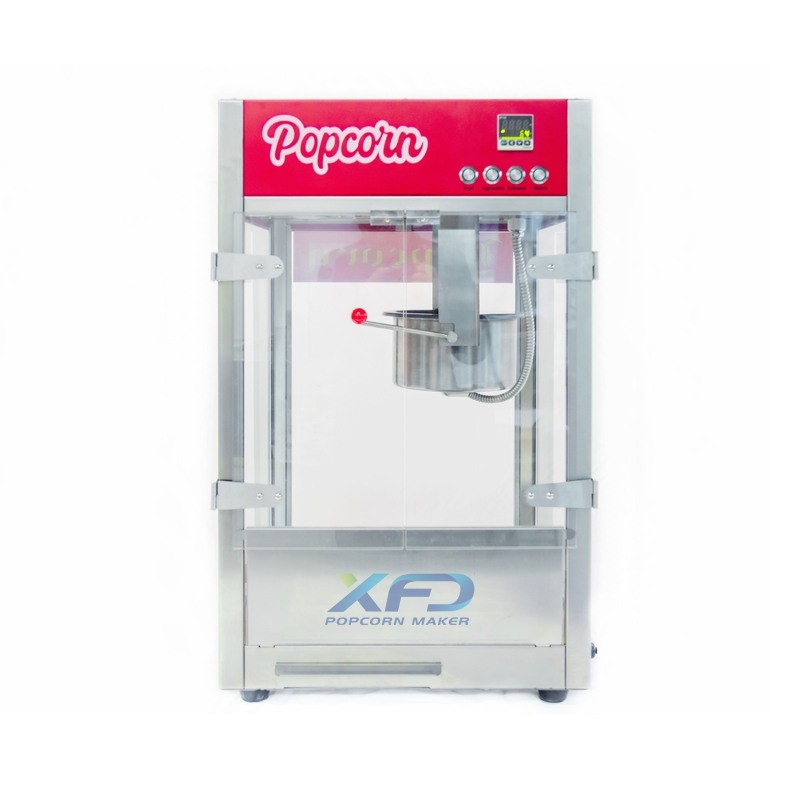
This type of machine works particularly well when the business already has a serving counter. Instead of purchasing a separate cart, the operator can place the popcorn machine where customers can see the popping process while keeping the rest of the counter available for packaging and sales.
A countertop format can also make sense for smaller snack shops, cafés, bars, school concession areas, entertainment venues, and compact food-service locations. XFD's Ultra 16 oz Table Model Popcorn Machine is described as a small-venue popcorn machine suitable for snack shops, drinks businesses, catering, and other commercial locations.
A cart popcorn machine combines the popping equipment with a mobile or standalone base. Instead of depending on an existing counter, the machine becomes its own operating station.
This design is especially useful when the popcorn machine needs to be moved, repositioned, or used in different areas. Festivals, fairs, school events, tourist attractions, shopping centers, entertainment venues, outdoor events, and temporary concession areas are common examples where a cart can be more practical than a fixed countertop unit.
XFD offers several mobile popcorn machine designs. Its Two-Wheel Antique Red Wagon Mobile Model Popcorn Popper Cart is a 16 oz mobile popcorn machine with a stainless steel welded frame, tempered safety glass, and two rubber road wheels. The product is positioned for retail, home theaters, schools, and other commercial applications.
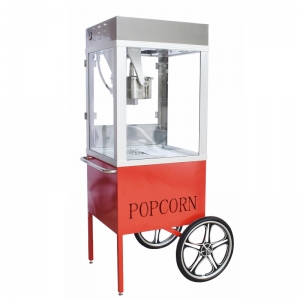
The visual presentation is another major advantage of a cart. A traditional popcorn cart can create an immediately recognizable concession atmosphere, while customized colors and branding can help the equipment become part of the customer's experience rather than simply another piece of food-service equipment.
XFD also provides a Four-wheel Wagon Mobile Popcorn Popper Cart . This type of wagon-style equipment provides an operating height designed for selling popcorn and includes storage space for additional products. It can be useful for festivals, tourist attractions, and other locations where a highly visible popcorn station is part of the sales strategy.
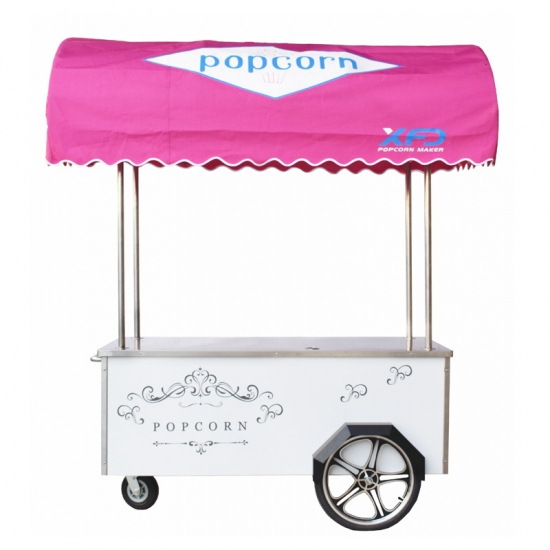
There is no universal winner between the two designs. Each one solves a different operational problem. The following comparison can help buyers identify which format is more suitable for their business.
| Factor | Countertop Popcorn Machine | Cart Popcorn Machine |
|---|---|---|
| Space | Uses an existing counter or table | Requires dedicated floor space |
| Mobility | Best for fixed locations | Better suited to mobile or flexible layouts |
| Installation | Simple placement on a suitable surface | Standalone equipment with a dedicated base |
| Visual Impact | Compact and integrated | Usually stronger as a standalone display |
| Best For | Snack shops, counters, cafés, cinemas, small venues | Events, festivals, schools, mobile concessions, tourist attractions |
| Branding | Usually depends on the surrounding counter | Cart structure provides additional branding opportunities |
For a small popcorn shop, a countertop machine can often be the more efficient choice if the store already has a suitable service counter. It keeps the equipment footprint relatively compact and allows the operator to use the remaining floor area for customer circulation, product displays, seating, or additional snack equipment.
However, if the shop relies heavily on visual merchandising, a cart can provide a stronger focal point. Customers can immediately see the machine, popcorn production, and serving area. This can be particularly useful for businesses where the popcorn-making process itself is part of the customer experience.
The decision should therefore be based on the layout rather than the size of the business alone. A small shop with strong walk-in traffic may benefit from a cart, while a larger shop with an established concession counter may still prefer a countertop model.
Cinemas generally have different requirements from small snack shops. Popcorn is often sold together with drinks and other concession products, so equipment layout, batch production, holding capacity, operator workflow, and customer throughput become more important.
For a cinema with a fixed concession counter, a countertop or floor-based commercial popcorn machine can be integrated into the existing service line. This can make it easier for staff to prepare popcorn and serve customers without moving the equipment.
XFD's Cinema Popcorn Machine range includes different popcorn machine configurations for cinema applications. The company also offers larger machines such as 32 oz to 36 oz cinema poppers, as well as automated popcorn equipment for locations with higher production requirements.
For a cinema, it is important not to choose a machine only because it looks compact. The actual kettle size, production cycle, heating method, holding system, cleaning process, and expected peak-hour demand should all be reviewed before purchasing.
A cart popcorn machine usually has the advantage in event environments because the equipment can function as a self-contained selling station. The cart format can also help separate popcorn production from other event equipment.
For festivals and temporary concessions, the visual appearance of the cart can be almost as important as the popping function. A colorful or customized cart can make the popcorn station easier to recognize from a distance and can help create a stronger food-service presentation.
XFD's mobile popcorn cart range includes two-wheel and four-wheel wagon designs. The two-wheel 16 oz model is described as suitable for retail, home theaters, schools, and similar commercial locations, while the four-wheel wagon is positioned for festivals, tourist attractions, and other selling environments where mobility and visibility matter.
Not necessarily. The cart design itself does not determine production capacity. A cart can be compact and relatively small, while some fixed popcorn machines can have much larger kettles and higher production rates.
This is an important point when comparing equipment. Buyers should compare the actual kettle capacity, production cycle, heating technology, power requirements, and operating method rather than assuming that a larger-looking cart automatically produces more popcorn.
For example, XFD offers small 10 oz and 12 oz tabletop equipment, 16 oz table models, 16 oz mobile cart equipment, and larger commercial and cinema machines. This range shows why machine format and production capacity should be considered separately.
Cleaning should be considered before purchasing any commercial popcorn machine. Popcorn production involves oil, kernels, seasoning, sugar, and other ingredients that can leave residue around the kettle and internal areas.
A countertop machine may be convenient when the operator has a dedicated cleaning area nearby. Because the equipment is integrated into a counter, however, the surrounding workspace should also be easy to access and clean.
A cart can be easier to approach from different sides, depending on its design, but the operator must also clean the cart base, wheels, storage areas, and surrounding surfaces. The best option is therefore the machine that fits the daily cleaning workflow of the business.
Several XFD machines include cleaning-oriented features. For example, the company's tabletop and commercial models describe auto kettle-cleaning functions, stainless steel structures, and modular designs intended to simplify maintenance.
Heating technology is another factor that should not be overlooked. Commercial popcorn machines can use different heating approaches, including electric heating and electromagnetic heating. The choice can affect heating speed, energy use, cleaning, control, and overall operating performance.
XFD's commercial popcorn machine range includes both electric and electromagnetic heating technologies. The company's electromagnetic popcorn machines are designed for commercial applications and are available in different machine configurations.
For businesses with frequent peak-hour demand, the heating system may be more important than whether the machine is countertop or cart style. A buyer should first define the required production level and then select the machine format that best fits the location.
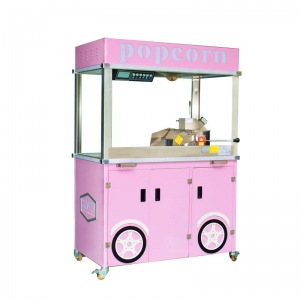
If your business operates from a permanent concession counter, has limited floor space, and does not need to move the popcorn equipment, a countertop popcorn machine is usually the more practical starting point.
If your business depends on events, outdoor selling, temporary concessions, or a highly visible standalone popcorn station, a cart popcorn machine may be the better fit.
There is also a third option worth considering: a floor model or larger commercial popcorn machine. This can be a better solution when production volume is more important than compactness. XFD's Commercial Popcorn Machine range includes different configurations for commercial venues, gourmet popcorn shops, canteens, arenas, and other food-service applications.
In other words, the selection process can be simplified as follows:
Fixed counter + limited space → Countertop machine
Mobile selling + events → Cart popcorn machine
High production demand → Larger commercial or cinema machine
Factory-scale production → Industrial popcorn equipment
Before requesting a quotation, buyers should provide more information than simply saying "I need a popcorn machine." A manufacturer can recommend a more suitable model when the operating conditions are clear.
Useful information includes the expected popcorn production per hour, preferred popcorn type, kettle capacity, available installation space, voltage and power requirements, whether the machine will be used indoors or outdoors, desired color or branding, and whether additional functions such as warming, seasoning, caramelizing, or self-service dispensing are required.
It is also helpful to explain where the machine will be used. A cinema concession stand has different requirements from a school event, while a gourmet popcorn shop may need different equipment from a large popcorn factory.
XFD provides popcorn equipment ranging from commercial and cinema popcorn machines to coating machines, staging cabinets, packaging equipment, ingredients, and industrial production lines. This broader equipment range can be useful when a business plans to expand from simple popcorn popping to flavoring, holding, and packaging.
So, which is better: a countertop popcorn machine or a cart popcorn machine?
The answer depends on the business model. A countertop popcorn machine is generally the better choice for a fixed concession area where space efficiency and integration with an existing counter are important. A cart popcorn machine is generally the better choice for mobile selling, events, festivals, schools, tourist attractions, and businesses where the popcorn station needs to attract attention.
Capacity should be evaluated separately from machine style. A countertop model is not automatically low capacity, and a cart is not automatically high capacity. Kettle size, heating technology, production cycle, operating workflow, and peak-hour demand are the factors that should ultimately determine the equipment specification.
For businesses comparing different options, XFD's range of commercial popcorn equipment provides multiple formats, from compact tabletop machines and mobile popcorn carts to cinema and industrial popcorn equipment. Selecting the right model based on the actual selling environment can help improve workflow, customer experience, and long-term equipment utilization.
1. Is a countertop popcorn machine better than a cart?
Neither is universally better. Countertop machines are usually better for fixed locations with limited floor space, while carts are better for mobile selling, events, and highly visible concession stations.
2. Are cart popcorn machines more powerful?
Not necessarily. Machine capacity depends on the kettle size, heating system, production cycle, and model design, not simply whether the machine has a cart.
3. What size popcorn machine is suitable for a small shop?
A small shop should consider a compact tabletop or small commercial popcorn machine. XFD offers 10 oz, 12 oz, and 16 oz models for different commercial applications.
4. Is a popcorn cart suitable for outdoor events?
Mobile popcorn carts can be a practical option for festivals, tourist attractions, schools, and temporary concession areas. The specific machine should still be selected according to power, weather, transportation, and event requirements.
5. Can popcorn machines be customized?
Some XFD popcorn machines and mobile cart models support customized colors and configurations. Buyers should discuss branding, color, voltage, and other requirements with the manufacturer before ordering.
6. Which popcorn machine is better for a cinema?
Cinemas should prioritize production capacity, peak-hour demand, heating technology, kettle size, cleaning, and workflow. Depending on the cinema size, a commercial or cinema popcorn machine may be more appropriate than a compact tabletop model.
7. Does a countertop popcorn machine save floor space?
Yes. Because it sits on an existing counter or table, it can reduce the amount of dedicated floor space required for the popcorn equipment.
8. Why choose a cart popcorn machine?
The main advantages are mobility, standalone operation, visual impact, and suitability for temporary or flexible concession layouts. A cart can also become part of the visual identity of a popcorn business.
9. What information should I provide when requesting a popcorn machine quotation?
Provide the expected production volume, kettle capacity, application, available space, voltage, preferred popcorn type, heating method if known, operating location, branding requirements, and any requirements for caramelizing, seasoning, warming, or self-service.
10. Can a popcorn machine manufacturer provide a complete popcorn production solution?
Yes. For businesses moving beyond individual popcorn machines, XFD also provides coating equipment, staging cabinets, packing machines, ingredients, and industrial popcorn production lines, allowing equipment selection to grow with the production requirements.
 No.58 TongMing Road,TongAn District,XiaMen City,FuJian Province
 +86-592-5701935
If you are interested in any XFD product, please leave us a message, we will reply to you soon.
Copyright © 2012-2026 XFD XIAMEN MACHINERY TECHNOLOGY LTD..All Rights Reserved.
 English
 Deutsch
 русский
 español
 português
 Nederlands
 العربية
 हिंदी
हिंदी